
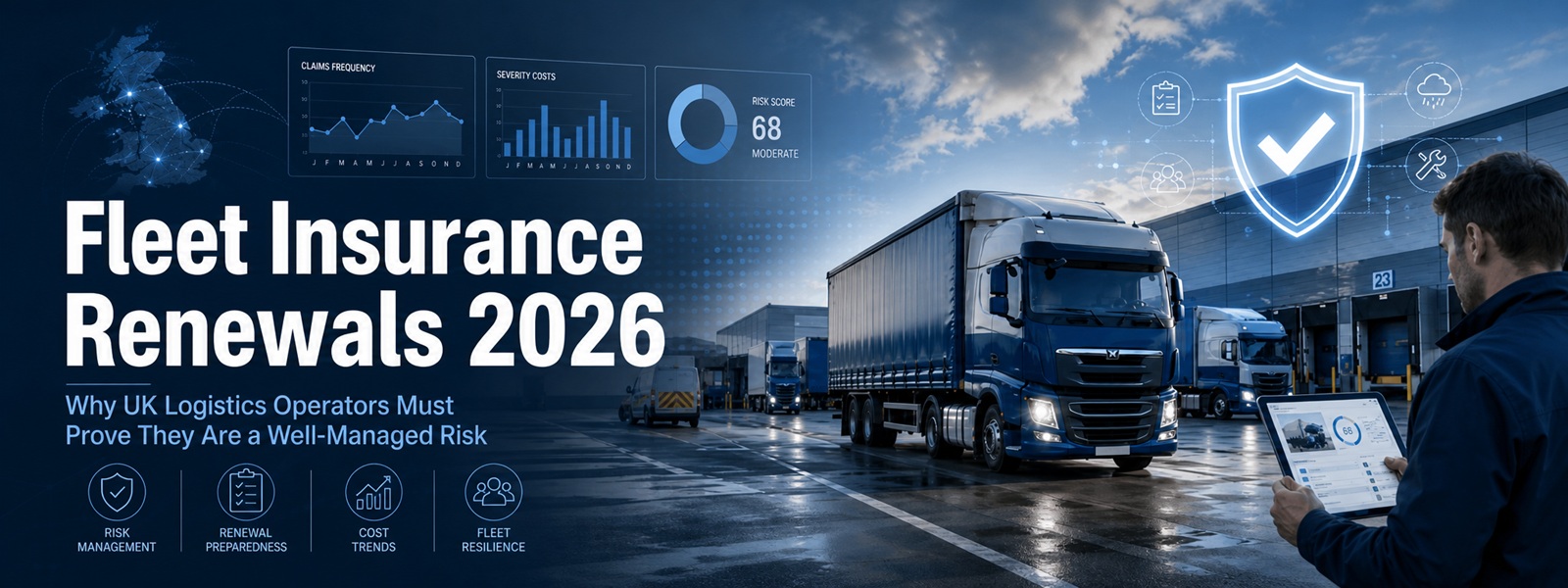
Fleet insurance is no longer just a renewal exercise. For UK logistics, haulage, transport and fleet operators, it is becoming a test of how well the business can evidence risk control.
The 2026 renewal environment is being shaped by several connected pressures: claims inflation, rising repair costs, vehicle downtime, driver behaviour, tighter underwriting scrutiny, electric vehicle repair complexity, connected fleet data and growing questions around cyber, telematics and future vehicle technology.
For many operators, the issue is not simply that premiums are rising.
The issue is that insurers now want clearer evidence.
Evidence of driver management.
Evidence of claims control.
Evidence of maintenance standards.
Evidence of safety technology.
Evidence of telematics use.
Evidence that the fleet is being actively managed, not simply insured.
That is why the central question for operators in 2026 is no longer:
“Can we get a cheaper renewal?”
It is:
“Can we prove to the market that we are a well-managed risk?”
Why Fleet Insurance Feels Different in 2026
The wider UK motor insurance market has seen periods of softening, but fleet and commercial motor remain under pressure because the underlying cost of claims has not gone away.
Recent market commentary has pointed to commercial fleet premiums rising significantly between 2023 and 2026, while claims inflation, repair complexity and vehicle technology continue to affect insurer pricing.
At the same time, insurers are dealing with higher repair costs, replacement vehicle costs, longer repair cycles, ADAS calibration, more complex parts, and the early realities of electric vehicle claims. Howden has highlighted how EVs are reshaping motor claims, with parts inflation, ADAS calibration and battery-related decisions creating new cost pressures.
For logistics operators, this matters because insurance costs are not isolated from the rest of the operation.
A collision is not just a claim.
It can mean:
- A vehicle off the road
- A driver unavailable
- A replacement vehicle is needed
- Missed delivery windows
- Customer disruption
- Additional administration
- Higher future premiums
- More scrutiny at renewal
In a sector built on availability, timing and service reliability, insurance is now closely linked to operational performance.
Key Pressures Operators Are Facing
1. Claims Inflation and Repair Complexity
Vehicle repairs are more expensive than they were a few years ago.
Modern commercial vehicles include more sensors, cameras, safety systems, software and specialist components. Even minor damage can require ADAS recalibration, specialist repair pathways and longer off-road periods.
For electric vans and trucks, the picture can become more complex again. Battery assessment, high-voltage safety, parts availability and specialist repair capability all affect claim cost and repair time.
That does not mean operators should avoid newer vehicles or EV transition. But it does mean renewal conversations need to include a clearer understanding of how vehicle mix, repair strategy, downtime and replacement arrangements affect risk.
2. Downtime Is Becoming Part of the Insurance Conversation
The true cost of an incident is rarely limited to the repair invoice.
If a van, rigid, tractor unit or specialist vehicle is off the road, operators may face lost productivity, vehicle hire, route disruption, driver rescheduling, service failure and customer penalties.
Insurers and brokers are therefore looking more closely at the wider risk picture.
Operators need to show:
- How incidents are reported
- How repairs are managed
- Whether vehicle downtime is tracked
- How quickly replacement vehicles are arranged
- Whether repeat incidents are investigated
- What is being done to reduce claim frequency
The better the evidence, the stronger the renewal conversation.
3. Driver Behaviour Remains Central
Driver behaviour remains one of the most important controllable risk factors in fleet insurance.
Speeding, harsh braking, distraction, reversing incidents, fatigue, poor route discipline and repeat minor claims can all affect how a fleet is viewed.
The difference in 2026 is that many operators now have more data available than ever before.
Telematics, dashcams, driver scoring, incident reports and vehicle camera systems can provide powerful evidence — but only if the data is being used properly.
It is not enough to simply have the technology installed.
Operators need to show what they are doing with the data:
- Are high-risk drivers being identified?
- Is coaching taking place?
- Are repeat behaviours being reduced?
- Are incident trends being reviewed?
- Is camera evidence helping defend claims?
- Is telematics data being used to improve safety?
For insurers, the key question is not only whether data exists.
It is whether the operator is acting on it.
4. Telematics and Connected Insurance Are Moving Further Into Haulage
The direction of travel is clear: fleet insurance is becoming more data-led.
A recent example is Flock’s haulage fleet insurance product backed by Admiral, launched in 2026, which uses telematics-based risk insights alongside underwriting and claims expertise.
For operators, this shows how the market is moving.
Fleets that can evidence safer driving, better risk management and stronger operational controls may be better placed to have constructive conversations with insurers.
This does not mean every operator needs to move immediately to a new connected insurance product.
But it does mean operators should expect more questions around:
- Telematics data
- Camera evidence
- Driver behaviour
- Claims trends
- Route risk
- Vehicle usage
- Fleet composition
- Incident response
- Safety interventions
Insurance is becoming less about static declarations and more about demonstrable risk management.
5. EVs, Alternative Fuels and New Vehicle Technology Add Uncertainty
The transition to electric and alternative fuel vehicles is creating new insurance questions.
Operators are having to understand:
- Higher repair costs
- Battery assessment and replacement decisions
- Charging infrastructure liability
- Specialist repair networks
- Vehicle downtime risk
- Residual value uncertainty
- Driver training requirements
- Fire and recovery protocols
- Data access after incidents
This does not make EVs uninsurable or unsuitable for logistics.
But it does mean operators should prepare better evidence before renewal.
A fleet introducing EVs should be ready to explain how vehicles are charged, maintained, monitored, repaired and used. The more clarity an operator can provide, the easier it becomes for insurers to understand the risk.
6. Automated and Connected Vehicles Are Changing the Long-Term Risk Picture
The Automated Vehicles Act 2024 created a framework for automated vehicles in Great Britain, including new legal concepts around responsibility when vehicles are operating in self-driving mode. Government guidance states that the Act establishes legal responsibilities, safety requirements and regulatory powers for automated vehicle deployment.
For many logistics operators, fully automated fleets may not be an immediate concern.
But the direction of travel matters.
Vehicle technology is becoming more connected, data-led and software-dependent. That affects future questions around liability, data access, claims investigation, cyber exposure and manufacturer/software responsibility.
Forward-thinking operators should expect insurance conversations to become more detailed as vehicle technology evolves.
What Insurers Want to See in 2026
Underwriters are increasingly looking for evidence that a fleet is being actively managed.
That means operators should prepare more than a claims history.
A stronger renewal submission may include:
- 12–24 months of claims data
- Telematics and driver behaviour trends
- Dashcam or video telematics evidence
- Driver training records
- Licence checking processes
- Maintenance and inspection records
- Incident reporting procedures
- Evidence of corrective action after claims
- Vehicle replacement and repair strategy
- EV or alternative fuel risk planning
- Written fleet risk policy
- Details of safety technology and how it is used
The aim is not to overwhelm insurers with data.
The aim is to tell a clear risk story.
A good renewal submission should show:
Here is where we were.
Here is what we have improved.
Here is how we manage risk.
Here is the evidence.
That is a very different conversation from simply asking the market for a price.
The 2026 Fleet Insurance Renewal Playbook
Operators with renewals approaching should start earlier than they may have done in the past.
Step 1: Build the Evidence Pack
Gather the core information before renewal discussions begin:
- Claims history
- Driver behaviour data
- Telematics reports
- Incident trends
- Vehicle mix
- Maintenance records
- Licence checks
- Training records
- Safety technology evidence
- Current risk management procedures
This should be pulled together in a way that is clear, concise and useful for underwriting.
Step 2: Identify the Main Risk Drivers
Operators should review where claims and costs are coming from.
Is the issue:
- Certain drivers?
- Certain routes?
- Certain depots?
- Reversing incidents?
- Low-speed collisions?
- Theft?
- Windscreen or body damage?
- EV repair costs?
- Vehicle downtime?
- Third-party injury claims?
The objective is to identify the three to five areas that are most affecting insurance performance.
Step 3: Act Before Renewal
The strongest operators do not wait until the renewal date.
They take action early.
That may include:
- Targeted driver coaching
- Reviewing high-risk routes
- Improving incident reporting
- Introducing camera evidence
- Reviewing claims defensibility
- Updating fleet risk policies
- Strengthening maintenance processes
- Reviewing vehicle allocation
- Preparing EV risk information
- Engaging a specialist broker earlier
Even if improvements are recent, they can still help demonstrate intent and control.
Step 4: Prepare a Clear Risk Narrative
Operators should work with their broker to present the business properly.
A good risk narrative explains:
- What the business does
- How the fleet operates
- What has changed since last renewal
- Where claims have occurred
- What actions have been taken
- How technology is being used
- How drivers are managed
- How maintenance is controlled
- What future risks are being planned for
This helps insurers understand the fleet beyond raw claims numbers.
Step 5: Ask Better Renewal Questions
Operators should be asking brokers and insurers more detailed questions, including:
- Which insurers are actively writing logistics and haulage fleet business?
- What specific improvements would make this fleet more attractive?
- How is claims inflation being applied to our renewal?
- How are EVs or alternative fuels being treated?
- What evidence would support a better rating conversation?
- Are telematics or video telematics being properly recognised?
- Would a higher excess or risk improvement plan change the outcome?
- How are downtime, replacement vehicles and claims defensibility being assessed?
Better questions create better conversations.
What a Well-Managed Risk Looks Like
A well-managed fleet is not necessarily a fleet with no claims.
It is a fleet that understands its risk, monitors it, acts on it and can evidence improvement.
In practical terms, that means:
- Clear ownership of fleet risk
- Regular review of claims trends
- Driver behaviour monitoring
- Licence checking
- Incident investigation
- Targeted training
- Vehicle maintenance controls
- Telematics and camera data use
- Written policies with driver sign-off
- Evidence of corrective action
- Early renewal preparation
- Strong broker engagement
This is where operators can take control.
The market may remain challenging, but a fleet that can evidence risk quality is in a stronger position than one that cannot.
Why This Matters Now
Fleet insurance is moving from a procurement exercise to a risk evidence exercise.
Operators that wait until renewal may find they are reacting to the market.
Operators who prepare earlier can shape the conversation.
That matters because many businesses are no longer waiting passively for renewal discussions. They are researching before renewal, comparing how other operators manage risk, looking at telematics and dashcam evidence, and trying to understand what insurers now expect.
By the time they speak to a broker, they may already have formed expectations around what “good” looks like.
The opportunity for operators is to make sure those expectations are grounded in practical, evidence-led risk management rather than guesswork.
Introducing the Fleet Insurance Reset Series
In response to the pressure operators are seeing across the network, the Logistics & Transport Network is launching a focused 10-week series:
Fleet Insurance Reset: Building Renewal Resilience Through Data & Transparency
The series is designed for logistics, haulage, transport and fleet operators with live or upcoming renewal exposure.
Across the series, we will cover:
- Why fleet renewals are becoming more forensic in 2026
- How claims inflation, repair costs and downtime are affecting premiums
- What insurers now expect from well-managed fleet risks
- How telematics, dashcams and claims data can strengthen renewal discussions
- How EVs, alternative fuels and connected vehicle technology are changing risk
- How operators can prepare earlier and build a stronger evidence pack
- What questions operators should ask their broker before renewal
- How to move from price-led renewal to risk-led renewal
The purpose is not to create fear around insurance.
It is to help operators move from uncertainty to preparation.
Who Should Engage?
This series is built for the people responsible for fleet risk, operational cost and renewal outcomes, including:
- Managing Directors and Owners
- Fleet Directors
- Transport Managers
- Operations Directors
- Finance Directors
- Risk and Compliance Leads
- Procurement and Commercial decision-makers
- Warehouse and Depot Managers with fleet responsibility
Whether you operate vans, HGVs, specialist vehicles, mixed fleets, EVs or multi-site transport operations, the series is designed to be practical and immediately useful.
The Bottom Line
The 2026 fleet insurance market is not simply about higher premiums.
It is about evidence.
Insurers want to understand which operators are managing risk properly and which are simply presenting a fleet for renewal.
For logistics and transport businesses, the strongest response is practical preparation:
- Know your claims data
- Understand your risk drivers
- Use telematics and camera evidence
- Manage driver behaviour
- Track downtime
- Prepare EV and technology risk information
- Start renewal conversations earlier
- Work with a broker who understands the sector
Renewal season is no longer just about getting the best price.
It is about proving you deserve the best possible outcome.
The data is clear.
The pressure is real.
The next step is preparation.
The first instalment of Fleet Insurance Reset: Building Renewal Resilience Through Data & Transparency begins shortly.
Make sure your organisation is part of the conversation.
This is an editorial article for informational purposes only. Logistics & Transport Network is not regulated by the Financial Conduct Authority (FCA) and does not offer regulated insurance or financial advice. The information provided should not be taken as personalised advice. Always consult an FCA-authorised professional before making decisions about your insurance cover.