

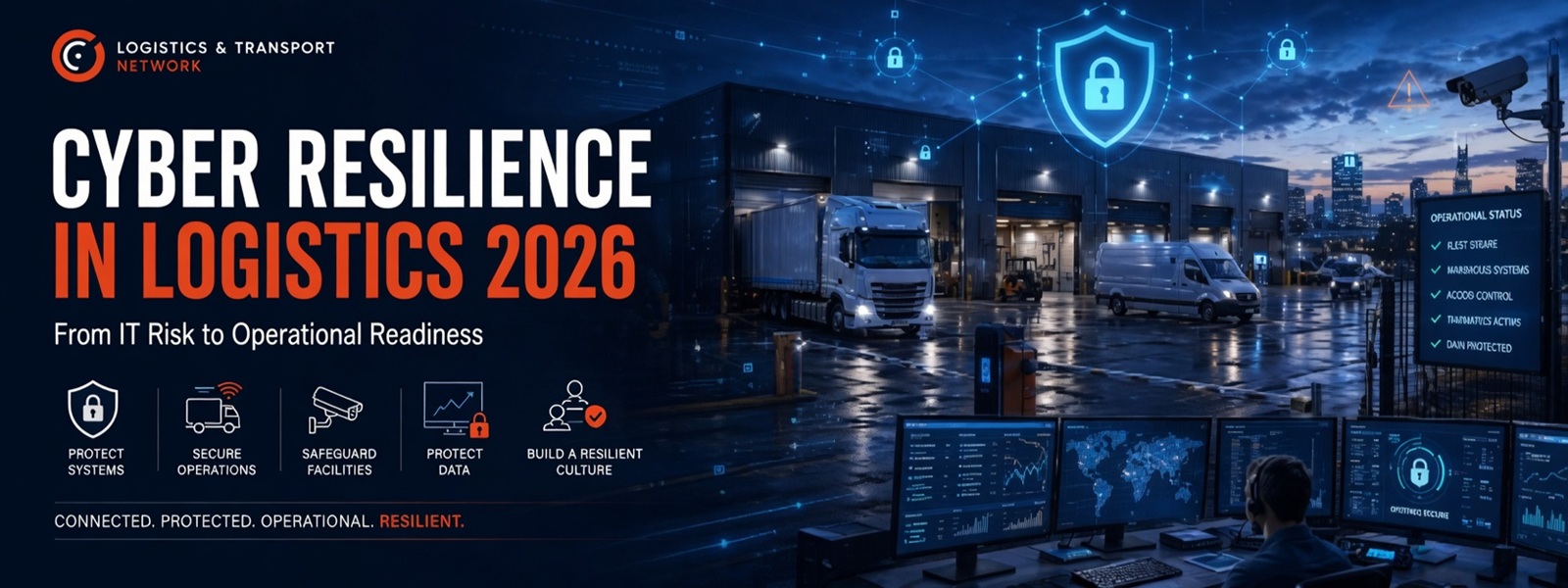
Cyber risk is no longer just about protecting data. For UK logistics, warehousing and transport operators, it is now about keeping freight moving, warehouses operating, customers informed and sites secure.
Cybersecurity in logistics is no longer only an IT issue.
In 2026, it is an operational resilience issue.
As logistics operators become more dependent on WMS/TMS platforms, telematics, driver apps, CCTV, access control, cloud systems, supplier portals, IoT devices, automation and connected fleet technology, cyber risk now reaches deep into day-to-day operations.
A serious incident can affect dispatch, warehouse activity, route planning, proof of delivery, customer visibility, stock control, payment systems, site access and even physical cargo security.
That is why cyber resilience needs to move from the IT checklist to the operational planning table.
The logistics sector does not need more fear-based cyber messaging. Operators need practical guidance: which systems are most critical, where the weak points are, which suppliers have access, how quickly the business could recover, and what evidence can be shown to customers, insurers and boards.
The good news is that this is not an unsolvable problem.
With the right structure, supplier support and internal ownership, logistics operators can reduce exposure, improve recovery capability and turn cyber resilience into a genuine operational strength.
Why Cyber Risk Has Become a Logistics Issue
Logistics has become more connected, more digital and more dependent on real-time systems.
That creates efficiency, visibility and service improvements, but it also increases exposure.
Modern logistics businesses now rely on connected systems for:
- Warehouse management
- Transport planning
- Telematics and fleet visibility
- Driver communication
- Digital proof of delivery
- Customer updates
- Route optimisation
- CCTV and access control
- Alarm signalling
- Yard management
- Fuel systems
- Payment terminals
- Supplier portals
- Freight platforms
- Cloud-based reporting
- Automation and IoT devices
If those systems are unavailable, compromised or manipulated, the impact can be immediate.
Vehicles may not be dispatched efficiently. Warehouses may struggle to process stock. Customers may lose visibility. Drivers may not receive updates. Sites may lose access control or monitoring. Management teams may lose the data needed to make operational decisions.
This is why cybersecurity is now tied directly to service delivery.
It is no longer simply about protecting files.
It is about protecting movement.
What Operators Are Really Worried About
Across logistics, warehousing and transport, the concern is not always expressed as “cybersecurity”.
Operators are more likely to describe practical worries:
“What happens if our transport system goes down?”
“Could our warehouse still operate if the WMS was unavailable?”
“Who has remote access to our CCTV, gates or alarms?”
“Are our telematics and vehicle systems secure?”
“Can we recover quickly if ransomware hits?”
“Would customers still trust us if we lost visibility for several days?”
“Do our suppliers meet the standards our customers are now asking from us?”
“Could a cyber issue lead to cargo theft or operational disruption?”
These are the questions that matter.
The real issue is not whether cyber sits under IT, operations, compliance or finance.
The real issue is whether the business can continue to operate when digital systems are under pressure.
That makes cyber resilience a board-level and operational issue.
The Threat Landscape Is Changing
The threat environment facing logistics operators has become more complex.
Ransomware remains a major risk, but attacks are evolving beyond simple data encryption. Criminal groups increasingly aim to disrupt operations, apply commercial pressure, steal sensitive information and exploit weaknesses in supply chains.
For logistics, that can be especially damaging because the sector depends on timing, visibility and trust.
An attack that interrupts warehouse operations, vehicle routing, customer communication or freight planning can create knock-on disruption quickly.
At the same time, criminals are becoming more sophisticated in how they target logistics businesses. Phishing, compromised supplier accounts, fake instructions, credential theft, invoice fraud, remote access abuse and attacks on connected systems can all create operational and financial exposure.
The risk is also amplified by the number of partners involved in modern logistics.
A single operator may depend on software vendors, telematics providers, warehouse systems, subcontractors, freight exchanges, customs platforms, payment systems, security providers, IT partners and customer portals.
That interconnected environment creates value.
It also creates risk.
The Hidden Weak Points Across Logistics Operations
Many cyber weaknesses are not obvious until something goes wrong.
Operators may have invested in modern systems while still carrying legacy infrastructure, unmanaged devices or unclear supplier access behind the scenes.
Common weak points include:
- Shared or weak passwords
- Limited use of multi-factor authentication
- Unpatched systems and unsupported software
- Poorly managed remote access
- Supplier accounts that have not been reviewed
- Flat networks with limited segmentation
- CCTV, access control or IoT devices connected without proper oversight
- Staff using personal devices or unmanaged endpoints
- Weak backup and recovery processes
- Limited logging and monitoring
- Unclear ownership between IT, facilities, security and operations
- Poor visibility of third-party platforms and integrations
- No tested incident response plan
In logistics, these weaknesses can have operational consequences.
A compromised account could expose customer data or routing information. Poorly secured remote access could allow attackers into operational systems. Weak backup processes could extend downtime. Insecure connected devices could create routes into wider networks.
The goal is not to make every business perfect overnight.
The goal is to identify the most critical weaknesses and address them in priority order.
Cyber-Enabled Cargo Theft: Where Digital and Physical Risk Meet
One of the most important logistics-specific risks is the growing connection between cyber compromise and physical theft.
Cargo crime is no longer only about breaking into a yard or intercepting a vehicle.
Criminals may use digital methods to support physical theft. That can include compromised email accounts, fake collection instructions, manipulation of load information, abuse of freight platforms, stolen credentials, telematics interference, or gaining access to operational data that reveals what is moving, when and where.
This matters because logistics businesses are built on trust between multiple parties.
Carriers, shippers, subcontractors, warehouses, freight brokers, drivers and customers often rely on shared information and fast communication.
If that information is manipulated, intercepted or misused, the consequences can be serious.
Cyber-enabled cargo theft highlights why cyber resilience and physical security can no longer be treated separately.
CCTV, access control, gate systems, driver verification, load instructions, telematics and supplier communication all need to be viewed as part of one risk environment.
Third-Party and Supplier Risk
Logistics operators rarely operate in isolation.
They depend on a wide ecosystem of suppliers and digital platforms.
That includes:
- WMS and TMS providers
- Telematics platforms
- Driver app providers
- Subcontractors
- Freight exchanges
- Customs and compliance systems
- Payment processors
- CCTV and access control providers
- Alarm monitoring companies
- IT and telecoms providers
- Cloud software vendors
- Maintenance and fleet technology suppliers
- Customer portals and integrations
Every connection can create exposure if it is not managed properly.
The question is not simply whether your own business is secure.
It is whether the systems and suppliers you rely on are secure enough for the role they play in your operation.
Operators should know:
- Which suppliers have access to systems or data
- What level of access do they have
- Whether MFA is required
- How supplier accounts are reviewed
- What happens when a supplier relationship ends
- Whether systems are monitored
- Whether suppliers have incident response processes
- Whether contracts include cyber and data obligations
- Whether critical suppliers can evidence basic cyber controls
This is becoming increasingly important as customers ask more questions about supply chain resilience.
A weak link in the supplier chain can quickly become an operational issue for the operator.
Why Customers, Insurers and Boards Now Care
Cyber resilience is becoming a commercial issue as well as an operational one.
Customers are increasingly asking suppliers to demonstrate stronger security, especially where logistics partners handle sensitive data, critical goods, high-value cargo, customer systems or time-sensitive operations.
Insurance providers are also looking more carefully at cyber controls, incident response, backups, MFA, ransomware preparedness and business continuity.
Boards and senior teams are asking harder questions because the financial and reputational impact of disruption can be significant.
For logistics operators, this means cybersecurity is no longer only about preventing an attack.
It is also about proving resilience.
Can the business show that it has identified its critical systems?
Can it evidence basic controls?
Can it demonstrate that supplier access is managed?
Can it recover if systems go down?
Can it continue serving customers during a disruption?
Can it show insurers and customers that cyber risk is being managed seriously?
Those questions are becoming part of commercial credibility.
The Practical 2026 Cyber Resilience Plan
The strongest response is structured, practical and proportionate.
Operators do not need to solve every cyber risk at once.
They need to understand where the most serious risks sit, which systems are most critical, and what actions will reduce exposure fastest.
Phase 1: Identify Critical Operational Systems
Start by mapping the systems the business cannot operate without.
This should include:
- WMS
- TMS
- Telematics
- Driver communication tools
- Customer portals
- CCTV and access control
- Alarm systems
- Payment systems
- Fuel systems
- Freight platforms
- Cloud systems
- Email and collaboration tools
- Backup systems
- Supplier portals
- Operational reporting
For each system, ask:
What does it do?
Who owns it?
Who has access?
What happens if it goes down?
How quickly could we recover?
Is there a manual workaround?
This gives operators a clear view of operational dependency.
Phase 2: Strengthen Access Controls
Many incidents begin with compromised access.
Operators should review:
- Multi-factor authentication
- Password controls
- User permissions
- Admin accounts
- Supplier access
- Remote access tools
- Leaver processes
- Shared accounts
- Access to cloud systems
- Access to operational systems
MFA should be prioritised for email, remote access, admin accounts, cloud systems, finance systems and operational platforms.
Access should also be reviewed regularly.
If someone no longer needs access, remove it.
If a supplier has access, document it.
If an account has admin privileges, challenge whether it is necessary.
These are basic steps, but they make a major difference.
Phase 3: Review Backups and Recovery
Backups are only useful if they work when needed.
Operators should review:
- What is backed up
- How often do backups run
- Where backups are stored
- Whether backups are isolated from the main network
- How quickly can systems be restored
- Whether restoration has been tested
- Which systems must be recovered first
- Who is responsible during recovery
For logistics businesses, recovery priority matters.
Email may be important, but WMS, TMS, customer portals, route planning, access control or payment systems may be even more operationally critical.
The business needs to know what must come back first.
Phase 4: Secure Connected Sites and Devices
Depots and warehouses now contain many connected devices.
This may include:
- CCTV cameras
- Access control systems
- Wi-Fi access points
- Scanners
- Tablets
- IoT sensors
- Telematics hardware
- Building systems
- EV chargers
- Alarm panels
- Gate systems
- Refrigeration monitoring
- Yard systems
Operators should understand which devices are connected, who manages them, whether they are patched, whether default passwords have been changed and whether they are separated from core business systems.
Connected devices should not be ignored simply because they sit outside traditional IT.
They are part of the cyber estate.
Phase 5: Assess Third-Party Risk
Operators should identify the suppliers that have access to systems, data or operational processes.
This should include software providers, IT partners, telecoms providers, security providers, subcontractors, finance systems, customer platforms and operational technology suppliers.
For critical suppliers, operators should ask:
- What access do they have?
- How is that access controlled?
- Do they use MFA?
- How are incidents reported?
- What happens if their system goes down?
- Do they hold customer or operational data?
- Are cyber responsibilities included in contracts?
- Can they evidence basic cyber controls?
The goal is not to create bureaucracy.
It is to understand which supplier relationships carry operational risk.
Phase 6: Prepare for Ransomware and Business Disruption
Operators should assume that prevention may not always be enough.
The question is: if an incident happens, can the business respond quickly and keep essential operations moving?
A practical response plan should cover:
- Who leads the response
- Who contacts IT, insurers, customers and suppliers
- Which systems are prioritised
- How drivers and warehouse teams are updated
- How customer communication is managed
- Whether manual processes can continue
- How evidence is preserved
- How recovery decisions are made
- Who has the authority to make urgent decisions
This plan should be tested.
Not once every few years.
Regularly.
A tabletop exercise can quickly reveal gaps that are invisible on paper.
Phase 7: Train Staff Around Real Logistics Threats
Cyber awareness training is more effective when it reflects the world people actually work in.
For logistics teams, training should cover:
- Fake collection instructions
- Suspicious supplier emails
- Invoice redirection
- Phishing linked to deliveries or customs
- Password sharing
- Driver communication scams
- Freight platform fraud
- Social engineering by phone
- Reporting lost devices
- Handling customer data
- Suspicious remote access requests
Warehouse teams, traffic planners, finance teams, drivers, customer service and management all face different risks.
Training should reflect those roles.
The goal is not to blame the staff.
It is to give them the confidence to spot and report issues early.
How Specialist Suppliers Can Help
The supplier market has evolved significantly.
The most valuable cyber partners are not simply selling software. They are helping operators understand risk, prioritise action and build resilience around the way logistics businesses actually operate.
Specialist support may include:
Cyber risk assessments
Helping operators identify critical systems, weak points, supplier access and operational exposure.
Managed Detection and Response
Providing 24/7 monitoring, threat detection and response support for businesses that do not have in-house security teams.
Endpoint and email security
Protecting devices, inboxes and users from malware, phishing, credential theft and ransomware.
Backup and disaster recovery
Designing recovery processes that prioritise essential logistics systems and reduce downtime.
OT, IoT and connected site security
Reviewing CCTV, access control, telematics, sensors, scanners, EV chargers and other connected devices.
Cyber Essentials and compliance support
Helping businesses evidence basic controls and respond to customer, insurer or procurement requirements.
Third-party risk management
Assessing suppliers, platforms and partners that have access to systems, data or operational processes.
Staff training and phishing simulation
Building awareness around threats that logistics teams are likely to encounter.
Incident response planning
Creating practical response plans and running exercises so teams know what to do when systems are disrupted.
The right supplier can help make cyber resilience practical, not overwhelming.
Real Momentum Is Building
Across the logistics sector, the cyber conversation is changing.
Operators are increasingly moving away from the question:
“Are we protected?”
And towards a more practical set of questions:
Which systems keep us operating?
Who has access to them?
What would happen if they went down?
How quickly could we recover?
Can we evidence our controls to customers?
Are our suppliers part of the risk?
Could a digital compromise create a physical loss?
Do our staff know what to report?
Are we prepared for ransomware?
These are the right questions.
They show that cybersecurity is becoming part of operational resilience, customer assurance and commercial credibility.
The operators who act now do not need to become cyber experts.
But they do need to understand their exposure, prioritise action and work with suppliers who can help them protect the systems that keep the business moving.
The Bottom Line
Cybersecurity in logistics has moved beyond the IT department.
It is now about operational readiness.
It affects freight movement, warehouse activity, driver communication, customer visibility, site security, cargo protection, supplier relationships and commercial trust.
The threat landscape is serious, but the response does not need to be fear-driven.
It needs to be structured.
Identify critical systems.
Control access.
Secure connected devices.
Review suppliers.
Test backups.
Prepare for ransomware.
Train staff around real logistics threats.
Work with partners who understand operational resilience.
The operators that take cyber resilience seriously in 2026 will be better placed to protect service, reassure customers, satisfy insurers and build stronger, more dependable operations.
Cyber risk may be rising, but so is the ability to manage it well.
Join the Cyber Resilience in Logistics Series
To support operators through this next stage of cyber planning, the Logistics & Transport Network will be developing a focused Cyber Resilience in Logistics Series.
The series will help logistics, warehousing, transport and fleet operators understand:
- How to identify critical operational systems
- Where hidden cyber weaknesses may exist across depots, warehouses and fleets
- Why supplier and third-party access needs closer review
- How ransomware can affect day-to-day operations
- What cyber-enabled cargo theft means in practice
- How Cyber Essentials and customer assurance expectations are changing
- Why connected devices, CCTV, access control, telematics and IoT need to be included in cyber planning
- Which specialist suppliers can help build practical cyber resilience
This series is designed to give operators practical guidance, supplier insight and a clearer route through the decisions that need to be made now.
To enrol your organisation or register interest in receiving the series, email:
Cyber risk is now part of logistics resilience. With the right planning, controls and supplier support, UK operators can protect their systems, keep freight moving and build stronger trust with customers.