

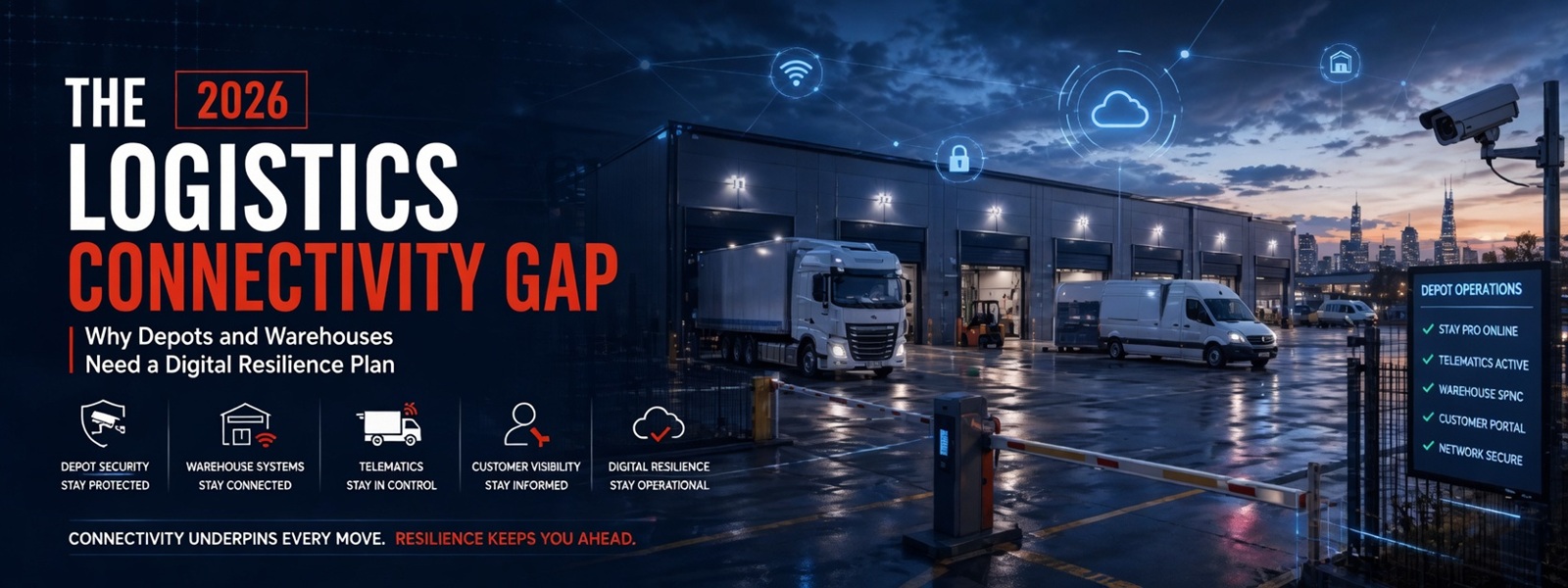
From CCTV and access control to WMS, telematics, alarms, vehicle cameras and customer visibility, logistics sites now depend on always-on connectivity. Here’s where the hidden risks are emerging — and how operators can build stronger, future-ready networks.
For UK logistics operators, connectivity is no longer just about broadband speed or whether the office phones work.
It now underpins almost every part of the operation.
Warehouse management systems. Transport management platforms. Telematics. Driver apps. Digital proof of delivery. CCTV. Access control. Yard systems. Vehicle cameras. Customer portals. Fuel systems. Payment terminals. Alarm signalling. EV charging. Remote monitoring. Cloud software. Cybersecurity. Automation.
The modern depot or warehouse is no longer a simple physical site.
It is a connected operating environment.
That creates a major opportunity for operators who get the foundations right. Better connectivity can support faster decisions, stronger visibility, more resilient security, smarter automation, better customer communication and more efficient site management.
But it also exposes a growing risk.
Many logistics sites have become digitally dependent without ever carrying out a proper review of whether their connectivity infrastructure is resilient enough to support the way the business now operates.
This is the 2026 logistics connectivity gap.
It is not one single issue. It is the gap between how connected logistics operations have become and how fragile, fragmented or outdated the underlying infrastructure may still be.
The operators that close this gap now will be better placed to support automation, customer visibility, security, EV transition and future site growth.
Those who delay may find that weak connectivity becomes a hidden constraint on operational performance.
Why This Has Become a 2026 Issue
The pressure has been building for years, but 2026 feels different.
Logistics and warehousing are moving from technology trials into operational execution. AI, automation and connected systems are increasingly being discussed as core drivers of competitiveness, compliance and operational resilience across the sector. Logistics UK’s 2026 AI and Automation Conference, for example, frames AI and automation as fundamentally reshaping logistics competitiveness and resilience.
At the same time, the UK’s legacy telecoms environment is reaching a hard deadline. Openreach says the existing analogue network will be switched off by 31 January 2027, and analogue phone lines have not been sold to new customers since September 2023. That matters because many business-critical devices can still depend on older connectivity arrangements, even where the main office systems appear modern.
The commercial pressure is also increasing. Recent reporting has highlighted that legacy business lines are facing steep price rises as the sector pushes remaining users away from old copper-based services, with hundreds of thousands of business lines still reportedly reliant on legacy infrastructure.
But this article is not really about PSTN.
The PSTN switch-off is only the trigger.
The bigger issue is this:
Logistics operators now need to understand whether every site has the connectivity, backup, resilience and supplier support needed for a more digital operating model.
What Operators Are Feeding Back
Across the sector, many operators are not describing one large connectivity failure.
They are describing a pattern of smaller frustrations and uncertainties.
A rural depot where broadband is unreliable.
A yard camera system that struggles with bandwidth.
A gate or access control system that drops offline.
A fuel island or payment terminal that still depends on legacy infrastructure.
A warehouse system that slows down at peak times.
Driver apps that work inconsistently in certain locations.
CCTV that cannot be monitored reliably off-site.
Alarm signalling that needs upgrading.
A site where one broadband outage affects too many systems at once.
A supplier saying “that’s an IT issue”, while IT says “that’s a telecoms issue”, and the alarm provider says “that’s a line issue”.
Individually, these issues can look like minor operational irritations.
Together, they point to something more serious: many logistics sites are running increasingly digital operations on infrastructure that was never designed for today’s level of dependency.
The concern from operators is not simply: “Do we have internet?”
It is:
If this connection fails, what stops working?
That is the question every depot, warehouse and transport site needs to answer in 2026.
Why Connectivity Is Now Operational Infrastructure
For logistics businesses, connectivity has moved from the background to the centre of the operation.
A warehouse management system needs reliable network access.
A transport management system depends on real-time updates.
Fleet visibility depends on telematics and vehicle data.
Customer service depends on accurate ETAs, proof of delivery and exception reporting.
Security depends on CCTV, access control and alarm monitoring.
Automation depends on low-latency, reliable data movement.
EV charging depends on connected chargers, load management and energy monitoring.
Cybersecurity depends on controlled, properly managed networks.
This means connectivity is now part of operational infrastructure in the same way as power, vehicles, racking, forklifts, loading bays and warehouse systems.
When connectivity fails, the impact is no longer limited to email or phone calls.
It can affect picking, dispatch, gate access, vehicle loading, route updates, customer visibility, payment processing, site security and driver communication.
That is why digital resilience is becoming a logistics issue, not just an IT issue.
The Hidden Weak Points Logistics Sites Need to Find
The biggest risk is often not the obvious connection.
It is the hidden dependency.
Many depots and warehouses have systems that were installed at different times by different suppliers, sometimes over many years. Each system may have its own line, router, SIM, alarm path, remote access arrangement or support contract.
Over time, the site becomes a patchwork.
Operators should be looking for hidden dependencies across:
- Fire alarms
- Intruder alarms
- CCTV and remote monitoring
- Door entry and access control
- Electric gates and barriers
- Weighbridges
- Fuel island systems
- Payment terminals
- Lift phones
- Emergency phones
- Older telemetry systems
- Building management systems
- Refrigeration monitoring
- Yard management systems
- Driver check-in systems
- Telematics and tracking devices
- EV chargers and load management systems
- Remote access tools used by suppliers
- Out-of-hours monitoring lines
- Legacy fax or backup lines are still used for specific workflows
The issue is not only whether these systems still work today.
The issue is whether they will continue to work reliably as the site becomes more digital, more automated and more dependent on real-time visibility.
The Problem With “Good Enough” Connectivity
Many logistics sites are still operating on connectivity that was originally installed for a much simpler business.
At the time, it may have been good enough.
Good enough for email.
Good enough for basic phone systems.
Good enough for occasional file transfers.
Good enough for a small office at the edge of a depot.
But modern logistics sites demand more.
They need to support cloud platforms, multiple users, high-definition CCTV, remote access, mobile devices, vehicle systems, scanners, IoT sensors, digital signage, Wi-Fi coverage, customer portals, security systems and, increasingly, automation.
A connection that looks acceptable on a speed test may still be weak operationally if it has poor resilience, limited backup, high latency, poor site coverage or no clear failover process.
This is why the question should not be:
“Is the broadband fast enough?”
The better question is:
“Is the site resilient enough if connectivity becomes business-critical?”
FTTP, SOGEA, Leased Lines, 5G and Satellite: The Real Question Is Fit
There is no single best connectivity option for every logistics site.
A small satellite office, a large warehouse, a cold chain depot, a rural transport yard and a high-throughput fulfilment centre may all need different solutions.
For some sites, FTTP may provide a strong step forward.
For others, a leased line may be more appropriate where guaranteed performance, service-level agreements and business-critical uptime are required.
Some sites may use SOGEA or business broadband as part of the mix.
Rural or edge locations may need fixed wireless, 4G/5G failover, bonded mobile connectivity or satellite backup.
Ports and large industrial zones are also seeing growing interest in private 5G and advanced wireless networks. Thames Freeport, for example, has invested in 5G infrastructure and is deploying connectivity innovations aimed at improving operational performance in port and logistics environments.
The right answer is not simply “buy fibre”.
The right answer is to match connectivity to operational need.
Operators should assess:
- What systems does the site depend on
- Which systems are business-critical
- How much downtime can the site tolerate
- Whether the location has reliable fibre options
- Whether a leased line is needed
- Whether 4G/5G failover is sufficient
- Whether satellite backup is appropriate for remote sites
- Whether SD-WAN could improve resilience across multiple locations
- Whether Wi-Fi coverage inside and outside the warehouse is strong enough
- Whether supplier-managed devices are secure and properly documented
- Whether the site has power backup for routers, switches and critical systems
This is why a site-by-site connectivity plan matters.
Digital Services Need Power, Backup and Failover
One of the most important shifts in digital migration is that more services now depend on power, routers, switches and broadband.
That changes the risk profile.
If a site loses power or its main connection drops, several systems can fail at the same time.
Voice.
Alarms.
CCTV.
Access control.
Warehouse systems.
Payment terminals.
Remote monitoring.
EV charging platforms.
This is where many operators discover that they have backup in theory, but not in practice.
A 4G router may exist, but has it been tested?
Does it cover the whole site?
Can it carry the required load?
Does it work inside a steel-framed warehouse?
Is the SIM active?
Does the firewall fail over automatically?
Do critical devices have UPS protection?
Does the alarm still signal during a power cut?
Does anyone receive an alert when a failover happens?
A resilience plan needs to answer these questions before a failure occurs.
Backup connectivity is not a box on a wall.
It is a tested process.
Cybersecurity Is Now Part of Connectivity Readiness
As more site systems move online, connectivity and cybersecurity become inseparable.
Every connected device can become a potential weak point if it is poorly managed.
CCTV cameras, access control systems, remote monitoring devices, routers, Wi-Fi access points, scanners, IoT sensors, building systems and supplier-managed equipment all need to be understood.
The risk is not only a major cyberattack.
It can also be weak passwords, unmanaged remote access, unsupported devices, flat networks, poor firewall rules, unpatched routers or suppliers having access that no one has reviewed for years.
This matters because logistics operations are increasingly data-rich and time-sensitive.
A cyber or connectivity incident can affect customer service, stock visibility, delivery schedules, vehicle movement, site security and operational continuity.
Operators should use connectivity upgrades as an opportunity to review:
- Network segmentation
- Firewall configuration
- Remote supplier access
- Device ownership
- Password and access controls
- Router and firmware updates
- Wi-Fi security
- Monitoring and alerting
- Backup and recovery processes
- Incident escalation procedures
Digital resilience is not only about staying connected.
It is about staying connected safely.
Automation Makes Connectivity Resilience More Important
The more automated a site becomes, the more important its digital foundations become.
Warehouse automation, robotics, digital twins, AI-led forecasting, predictive maintenance and real-time yard visibility all depend on reliable data flow.
Recent coverage of warehouse automation has highlighted how robotics and intelligent systems are becoming more central to warehouse operations, with reliable connectivity increasingly important for technologies such as mapping, safety systems and real-time operational coordination.
This does not mean every warehouse needs advanced robotics today.
But it does mean every operator should think about the direction of travel.
If a site may need automation, EV charging, advanced CCTV, digital yard management, customer visibility or predictive maintenance in the next few years, the connectivity plan should be built with that future in mind.
The worst outcome is to invest in new systems and then discover the site infrastructure cannot support them properly.
Connectivity should not be an afterthought.
It should be part of the operational roadmap.
The Immediate Risks for Depots and Warehouses
The connectivity gap creates several practical risks for operators.
Operational Disruption
A connection failure can affect warehouse systems, transport planning, customer updates, driver communication, gate access, payment systems and security monitoring.
Security Exposure
CCTV, alarms and access systems may be weakened by poor connectivity, legacy lines, weak backup or unmanaged devices.
Poor Customer Visibility
Customers increasingly expect accurate delivery updates, proof of delivery, exception reporting and real-time communication. Weak connectivity makes this harder to deliver.
Increased Supplier Confusion
When systems fail, responsibility can be unclear. Is it the telecoms provider, IT partner, alarm supplier, software vendor, mobile network, facilities contractor or internal team?
Slower Automation Adoption
Operators may struggle to implement automation, IoT, AI systems or smart yard tools if the site network is not strong enough.
Hidden Compliance and Safety Risk
Fire alarms, emergency lines, refrigeration monitoring, access systems and safety-related devices may depend on infrastructure that has not been reviewed properly.
Higher Costs Later
Leaving upgrades until a system fails usually increases urgency, reduces supplier choice and creates avoidable disruption.
The positive point is that these risks are manageable.
But they need to be identified early.
What a Good Connectivity Resilience Plan Looks Like
The best approach is not to buy a single product.
It is to create a site-by-site digital resilience plan.
That plan should answer three questions:
- What does each site depend on?
- What happens if the connection, power or supplier system fails?
- What needs to change to make the site resilient enough for the next stage of operations?
A strong plan should include:
- A full audit of all connectivity services
- A map of critical systems and dependencies
- Identification of legacy lines and hidden analogue dependencies
- Review of broadband, fibre, leased line, mobile and satellite options
- Primary and backup connectivity design
- Failover testing
- Power backup review
- Wi-Fi and yard coverage assessment
- Cybersecurity review
- Supplier access review
- Responsibility matrix for all systems
- Site-by-site upgrade roadmap
- Ongoing monitoring and support model
This is the shift operators need to make.
From connectivity as a utility.
To connect as operational resilience.
Your 2026 Logistics Connectivity Action Plan
Phase 1: Audit Every Site
Operators should start by mapping every depot, warehouse, office, yard and outstation.
For each site, identify:
- Primary internet connection
- Backup connection
- Phone systems
- Alarm lines
- CCTV connectivity
- Access control systems
- Gate and barrier systems
- Warehouse systems
- Transport systems
- Payment terminals
- Fuel systems
- Weighbridges
- Mobile coverage
- Wi-Fi coverage
- Remote supplier access
- Any remaining PSTN, ISDN or legacy line dependencies
This creates the baseline.
Without it, operators cannot know where the real risk sits.
Phase 2: Classify Critical Systems
Not every system carries the same risk.
Operators should classify systems by operational importance.
For example:
Critical: alarms, access control, WMS, TMS, CCTV monitoring, emergency communication, payment terminals, fuel systems, refrigerated monitoring, EV charging platforms.
Important: office systems, reporting tools, customer portals, driver communication systems, and telematics dashboards.
Supportive: non-urgent administrative tools, guest Wi-Fi, secondary reporting or low-impact systems.
This helps prioritise investment.
The goal is to protect what the site cannot operate safely or effectively without.
Phase 3: Review Primary Connectivity
Operators should assess whether each site has the right primary connection for its operational role.
Questions include:
- Is FTTP available?
- Is a leased line required?
- Is SOGEA sufficient for the site’s workload?
- Is mobile broadband viable?
- Is fixed wireless or satellite needed for rural sites?
- Does the connection have the right SLA?
- Is latency suitable for cloud systems and voice?
- Is bandwidth enough for CCTV, WMS, TMS and future systems?
- Is the site likely to need more capacity over the next three years?
The answer may vary by site.
That is why a single procurement decision across all locations may not be the best approach.
Phase 4: Build Backup and Failover
Every critical site should have an appropriate backup plan.
This may include:
- 4G or 5G failover
- Secondary fixed connection
- Diverse routing is available
- SD-WAN across multiple connections
- Satellite backup for remote locations
- UPS protection for routers and switches
- Battery backup for alarm and voice systems
- Clear failover alerts and testing schedules
Backup should not be assumed.
It should be tested.
Operators should know what continues to work during failover, what slows down, what stops, and who is alerted.
Phase 5: Review Cybersecurity and Supplier Access
A connectivity upgrade is the right moment to review digital security.
Operators should ask:
- Who has remote access to site systems?
- Are CCTV and access control devices segmented from core business systems?
- Are routers and firewalls properly managed?
- Are passwords and credentials controlled?
- Are supplier connections documented?
- Are devices patched and supported?
- Is Wi-Fi secure?
- Are logs monitored?
- Is there an incident response process?
This is particularly important where logistics sites use multiple external suppliers for alarms, CCTV, gates, software, telecoms, IT and facilities.
Someone needs ownership of the full picture.
Phase 6: Create a Site Connectivity Roadmap
Finally, operators should create a practical roadmap.
This should prioritise:
- Sites with the highest operational dependency
- Sites with known weak connectivity
- Sites with remaining legacy infrastructure
- Sites with poor backup
- Sites planning automation, EV charging or expansion
- Sites with security or compliance-critical systems
The roadmap should include short-term fixes and longer-term improvements.
Some actions may be immediate.
Others may be phased over 6–18 months.
The important point is that connectivity becomes part of operational planning, not reactive troubleshooting.
How Specialist Suppliers Can Help
The right supplier support can turn a confusing, fragmented issue into a clear upgrade plan.
Suppliers can support operators through:
Connectivity audits
Identifying current services, legacy dependencies, hidden risks and site-specific weaknesses.
FTTP, leased line and business broadband provision
Matching the right primary connection to each site’s operational needs.
4G/5G failover and bonded connectivity
Providing backup options for sites where downtime would cause disruption.
SD-WAN and multi-site network management
Helping operators manage connectivity across multiple depots and warehouses more intelligently.
Satellite and fixed wireless solutions
Supporting rural, remote or hard-to-connect sites where fibre options are limited.
Alarm, CCTV and access control migration
Ensuring security and safety systems continue to operate reliably in a digital environment.
Managed IT and cybersecurity support
Reviewing segmentation, remote access, firewalls, device management and monitoring.
Wi-Fi and yard coverage design
Ensuring handheld devices, scanners, tablets, driver systems and outdoor operations have reliable coverage.
EV charging and energy system connectivity
Making sure chargers, load management, payment systems and monitoring platforms are properly connected and resilient.
The best partners will not just sell a connection.
They will help operators understand how the site works and design resilience around the operation.
The Bottom Line
The 2026 logistics connectivity gap is not about one technology deadline.
It is about operational readiness.
Depots and warehouses have become more digital, more connected and more dependent on real-time systems.
But many sites still have hidden weak points: legacy lines, poor backup, patchy Wi-Fi, weak mobile coverage, unclear supplier ownership, unmanaged devices and limited cyber controls.
The solution is not panic.
It is structured.
Audit the site.
Map the dependencies.
Identify the weak points.
Prioritise critical systems.
Build primary and backup connectivity.
Review cybersecurity.
Test failover.
Create a site-by-site roadmap.
The operators who do this now will not only reduce risk.
They will build stronger foundations for automation, customer visibility, EV charging, site security and future logistics performance.
Connectivity is no longer just an IT cost.
It is a core part of operational resilience.
Join the Digital Connectivity Readiness Series
To support operators through this next stage of digital site planning, the Logistics & Transport Network will be developing a focused Digital Connectivity Readiness Series.
The series will help UK logistics, warehousing, depot and transport operators understand:
- How to identify hidden connectivity risks across their sites
- Which systems may still depend on legacy lines or weak infrastructure
- Why backup, failover and power resilience now matter more than ever
- How FTTP, leased lines, SOGEA, 4G/5G, satellite and SD-WAN fit different site needs
- What cybersecurity risks can emerge as more systems move online
- How to support WMS, TMS, CCTV, access control, telematics, EV charging and automation
- Which specialist suppliers can help operators build stronger, future-ready connectivity
This series is designed to give operators practical guidance, supplier insight and a clearer route through the decisions that need to be made now.
To enrol your organisation or register interest in receiving the series, email:
The connectivity gap is real, but with the right planning, technology and supplier support, logistics operators can turn hidden infrastructure risk into stronger, smarter and more resilient operations.