

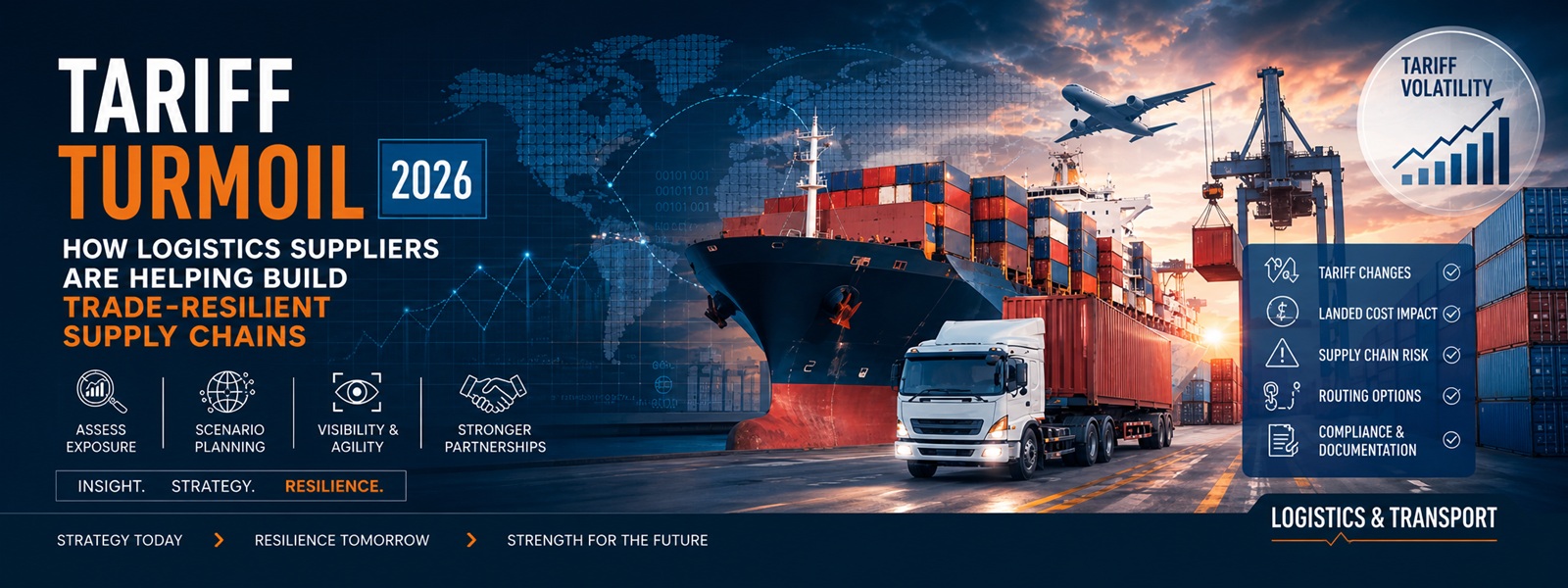
US tariff volatility is reshaping global trade — here’s what it really means for UK operators, the current and future impacts, and the practical steps businesses can take now with supplier support to protect margins and build resilience.
Tariff volatility has become one of the defining logistics and supply chain pressures of 2026.
What began as policy uncertainty has now become a practical operating challenge, forcing UK importers, exporters, freight forwarders, 3PLs, manufacturers, retailers and supply chain teams to rethink landed costs, sourcing strategies, routing decisions, inventory planning and contract terms.
This is not simply a tariff issue.
It is a trade resilience issue.
Recent global trade research shows that supply chain concerns have risen sharply year-on-year, with tariff volatility now one of the most significant regulatory and customs pressures facing trade professionals. More than three-quarters of trade professionals believe the current wave of US tariffs represents a longer-term shift rather than a short-term negotiating tactic.
For UK businesses, this is not a distant problem.
It is already influencing landed cost calculations, supplier decisions, customer pricing, customs documentation, freight routing and contract discussions.
But the response does not need to be panicked.
The opportunity now is to move from reactive firefighting to proactive trade resilience — building supply chains that are more visible, more flexible, more compliant and better prepared for the next policy shift.
That is where specialist logistics suppliers, customs partners, visibility platforms, trade management systems and finance providers are becoming increasingly important.
The businesses that act early will not simply protect margins.
They will build more intelligent supply chains because of the pressure.
What Is Actually Happening in 2026?
The current environment is being shaped by a combination of tariff changes, trade policy uncertainty and wider global supply chain fragmentation.
For UK operators, the key pressures include:
- Rapid changes to tariff rates, exemptions and product classifications
- New or expanded duties on categories including steel, aluminium, vehicles, automotive parts, electronics, components and consumer goods
- Increased pressure on customs documentation, classification accuracy and origin evidence
- Knock-on effects on ocean freight, air freight and multimodal routing as businesses reassess high-cost lanes
- Greater complexity in pricing, contract terms, supplier agreements and customer commitments
- Secondary impacts on currency movements, raw material pricing and inventory carrying costs
The UK has been directly exposed to recent US tariff measures, including tariffs on steel, aluminium, passenger vehicles, light trucks and automobile parts. The House of Commons Library has also highlighted the wider uncertainty created by changes to the legal and policy basis for US tariff action.
Unlike previous trade disputes, the 2026 landscape feels more changeable and less predictable.
For logistics operators and their customers, this means that a lane, supplier base or product category that looked commercially viable six months ago may now need to be reviewed again.
That does not mean every business needs to redesign its entire supply chain overnight.
But it does mean every business needs to understand where it is exposed.
Why This Matters for UK Logistics Operators
For UK operators, the impact is not limited to businesses shipping directly to or from the United States.
Tariff volatility can affect:
- UK exporters selling into the US
- UK importers sourcing finished goods, components or raw materials from tariff-affected regions
- Freight forwarders advising customers on routing, documentation and landed costs
- 3PLs supporting clients with warehousing, fulfilment and inventory strategy
- Manufacturers reviewing supplier bases, production inputs and customer pricing
- Retailers managing product availability, margin pressure and stock planning
This comes at a time when many UK businesses are already managing complex trading conditions, including post-Brexit border processes, EU regulatory requirements, customs documentation pressures, geopolitical disruption and ongoing freight market uncertainty.
That is why trade resilience is becoming a board-level logistics issue.
It is no longer just a customs question.
It affects pricing, cash flow, customer service, stock availability, supplier relationships and long-term competitiveness.
The Shift: From Lowest Cost to Best Options
For many years, supply chains were designed primarily around efficiency: lowest cost, lean stock, streamlined sourcing and predictable flows.
That model is now under pressure.
The World Economic Forum’s 2026 Global Value Chains Outlook describes a shift away from long, linear supply chains optimised mainly for efficiency, towards digitally enabled, more adaptable systems using nearshoring, dual sourcing, AI-driven forecasting, compliance agility and scenario modelling.
For operators, the lesson is clear:
The goal is no longer simply to design the cheapest supply chain.
It is to design a supply chain with options.
That means knowing:
- Which lanes are most exposed to tariff changes
- Which suppliers create the highest margin risk
- Which product categories are vulnerable to reclassification or origin challenges
- Which customers may need pricing conversations
- Which alternative ports, modes or fulfilment options are realistic
- Which stock strategies improve resilience without tying up unnecessary capital
This is where good supplier support becomes valuable.
The right logistics and trade partners can help operators see the risk earlier, model the options more clearly and make better decisions before pressure turns into disruption.
Current and Future Impacts on UK Logistics
Right Now
In Q2 2026, many businesses are reviewing their tariff exposure and landed cost assumptions.
Importers and exporters are having to assess whether duties, origin rules, product classifications or supplier locations are changing the real cost of goods.
Freight forwarders, customs brokers and 3PLs are seeing more requests for classification reviews, tariff engineering, alternative routing, duty calculation, origin analysis and customs compliance support.
Procurement and logistics teams are also being pulled into more frequent pricing and contract conversations, as businesses try to decide whether tariff exposure should be absorbed, passed on, renegotiated or mitigated through operational change.
For some operators, inventory strategies are also shifting.
Some are building buffer stock to protect customer service, while others are reducing exposure by reviewing alternative sourcing, regionalised supply, secondary ports or more flexible warehousing options.
Looking Ahead
Over 2027 and 2028, tariff volatility may accelerate several longer-term changes:
- More regionalised supplier networks
- Greater use of dual sourcing and supplier diversification
- More demand for customs and compliance expertise
- Increased use of landed-cost modelling and scenario planning tools
- Stronger integration between procurement, logistics, finance and compliance teams
- Greater interest in bonded warehousing, customs warehousing and flexible fulfilment models
- More pressure on freight partners to provide advisory support, not just transport capacity
The operators who treat this as a temporary blip may face repeated margin erosion.
Those who treat it as a catalyst for building more resilient, flexible and data-led networks will be better placed to protect both service levels and profitability.
Compliance Is Becoming a Competitive Advantage
In a volatile tariff environment, mistakes in classification, valuation or country-of-origin evidence can become expensive very quickly.
Operators need to be able to evidence:
- Why was a tariff code used
- How the origin was determined
- What valuation method was applied
- Which documentation supports the customs position
- How decisions were made when rules changed
- Whether supplier declarations and trade records are up to date
This makes trade compliance more than an administrative task.
It becomes a margin-protection tool.
The businesses that can move quickly while keeping accurate, auditable records will be better placed to avoid delays, disputes, penalties and unexpected duty exposure.
This is also changing the role of customs brokers, freight forwarders and trade technology providers.
The most valuable partners are not simply processing paperwork.
They are helping businesses make defensible, data-backed decisions in a changing trade environment.
Why Waiting for Certainty Is a Risk
One of the hardest parts of tariff volatility is that businesses naturally want clarity before making decisions.
But waiting for full certainty can create its own risk.
Tariff frameworks may change. Exemptions may shift. Legal mechanisms may be challenged. Trading partners may respond with their own measures.
But customers still need stock.
Contracts still need pricing.
Goods still need to move.
Margins still need protecting.
The practical response is not to predict every policy decision correctly.
It is to build a supply chain that can adapt when the rules change.
That means creating better visibility, cleaner data, faster decision-making and stronger supplier partnerships.
Your Proactive Trade Resilience Action Plan
Here is the practical framework that leading UK and European operators are now starting to implement.
Step 1: Map Your True Tariff Exposure
Start with the products, suppliers and lanes that matter most.
Operators should review the top 80% of spend, volume or margin exposure and identify where tariff changes could materially affect costs.
This should include:
- SKU-level tariff and origin analysis
- Review of product classifications and duty rates
- Identification of high-risk suppliers, countries and trade lanes
- Assessment of which products are most sensitive to tariff movement
- Calculation of the margin impact if duties rise by 10%, 20% or more
- Working capital modelling for different stock strategies
The goal is to create a clear picture of where the business is exposed — not just at headline level, but by product, customer, supplier and route.
Step 2: Build Scenario Planning Capability
Once exposure is mapped, operators need to model different outcomes.
This includes best case, base case and worst case scenarios across tariffs, routing, sourcing, lead times and inventory.
Questions to ask include:
- What happens if tariffs rise again on a key category?
- What happens if an exemption is removed?
- What happens if a supplier becomes uneconomic?
- What happens if a customer refuses to accept price increases?
- What happens if a primary port or lane becomes less viable?
- What happens if the stock needs to be held closer to the customer?
This is where scenario planning tools, AI analytics, landed-cost platforms and specialist consultants can help operators move from guesswork to structured decision-making.
Step 3: Strengthen Visibility and Agility
Tariff volatility creates pressure because many businesses do not have a real-time view of cost, compliance and movement across their supply chains.
Operators should review whether they have visibility over:
- Shipment location and expected arrival
- Current and forecasted landed costs
- Duty exposure by product and lane
- Customs status and documentation gaps
- Supplier risk and lead-time changes
- Stock levels across warehouses and fulfilment locations
Visibility does not remove volatility.
But it gives businesses more time to respond.
When logistics, procurement, finance and customs teams are working from the same data, decisions can be made faster and with more confidence.
Step 4: Review Contracts, Pricing and Supplier Terms
Tariff volatility needs to be reflected in commercial agreements.
Operators should review contracts with customers, suppliers, carriers, forwarders and 3PLs to understand how tariff changes, duty exposure and unexpected cost increases are managed.
This may include:
- Tariff volatility clauses
- Price adjustment mechanisms
- Lead-time and service-level flexibility
- Shared-cost arrangements
- Clear responsibility for customs documentation
- Rules around origin evidence and supplier declarations
- Renegotiation triggers when duty exposure changes materially
This is not about making contracts more complicated for the sake of it.
It is about making sure the cost risk is understood before it becomes a dispute.
Step 5: Build Supplier Optionality
Resilience does not always mean bringing production home.
In some cases, reshoring may be appropriate.
In others, dual sourcing, nearshoring, supplier diversification, alternative ports, bonded warehousing or multimodal routing may be more practical.
The key is optionality.
Operators should identify:
- Secondary suppliers in lower-risk locations
- Alternative ports and routing options
- Warehousing strategies that allow stock to be held closer to demand
- Customs warehousing or bonded solutions where appropriate
- Forwarders with strong tariff-aware routing capability
- Technology providers that can model landed cost before decisions are made
The aim is not to remove every risk.
It is to avoid being trapped by one route, one supplier, one classification assumption or one cost model.
How Leading Logistics Suppliers Are Helping Right Now
The most forward-thinking suppliers have moved beyond generic advice and are helping operators take practical action.
This includes:
Freight forwarders with tariff-aware routing capability
Helping customers compare routes, modes, ports, lead times, and landed costs before goods move.
Customs brokers and trade compliance specialists
Supporting classification reviews, origin evidence, documentation accuracy and customs defensibility.
Global Trade Management platforms
Automating tariff classification, duty calculation, origin management, denied-party screening and compliance workflows.
Supply chain visibility and control tower providers
Giving operators clearer real-time oversight of shipments, costs, delays, risks and documentation status.
AI scenario modelling and landed-cost analytics tools
Helping teams model tariff changes, supplier alternatives, routing scenarios and margin impacts quickly.
Warehousing and inventory optimisation partners
Supporting buffer stock strategies, bonded warehousing, regional fulfilment and more flexible stock positioning.
Nearshoring and supplier diversification consultants
Helping businesses qualify new suppliers, compare landed costs and assess operational viability.
Trade finance and working capital providers
Helping businesses manage the cash flow implications of higher duties, buffer stock or longer lead times.
Legal, tax and advisory partners
Supporting contract terms, customs exposure, duty mitigation and cross-border risk management.
These solutions are not about adding complexity.
They are about giving operators more control.
The right supplier ecosystem can help a business understand its exposure, model its options and act before disruption reaches the customer.
Real Momentum Is Already Visible
Across the UK market, the conversation is changing.
More manufacturers, retailers, importers, exporters, freight forwarders and logistics operators are moving tariff risk from the background into active planning.
Trade, logistics and procurement teams are being asked more strategic questions:
Where are we exposed?
Which suppliers create risk?
How confident are we in our classifications?
Can we evidence origin?
What happens if this duty changes again?
Which routes give us options?
How quickly can we switch?
What would this do to the margin?
These are not theoretical questions.
They are now part of everyday commercial resilience.
The positive news is that businesses do not need to solve every issue at once.
A structured approach — supported by the right suppliers — can quickly identify where action is most urgent and where resilience can be built over time.
The Bottom Line
Tariff turmoil in 2026 is genuine pressure.
But it is also a catalyst for building stronger, more intelligent supply chains.
The operators who will thrive are those who move from reactive firefighting to proactive resilience-building.
That means:
- Understanding true tariff exposure
- Improving classification and origin confidence
- Building better landed-cost visibility
- Creating routing and supplier optionality
- Strengthening compliance records
- Reviewing the contract and pricing mechanisms
- Working with suppliers who can provide practical tools, data and expertise
This is not about hoping tariffs go away.
It is about building a supply chain that can perform whether tariffs rise, fall or shift again next quarter.
The businesses that act now will be better prepared, more commercially resilient and more confident in the face of continued trade uncertainty.
Join the Trade Resilience Series
To support operators through this period of tariff volatility and trade disruption, the Logistics & Transport Network will be developing a focused Trade Resilience Series.
The series will help UK logistics, freight, warehousing, procurement and supply chain teams understand:
- How to assess tariff exposure across products, suppliers and lanes
- How landed-cost modelling can protect margins
- Why classification, origin and customs evidence now matter more than ever
- How alternative routing, dual sourcing and nearshoring can improve resilience
- What role can visibility platforms, GTM systems and AI scenario tools play
- How warehousing, finance and supplier partnerships can reduce commercial risk
- Which specialist suppliers are actively helping operators respond to tariff volatility
This series is designed to give operators practical guidance, supplier insight and a clearer route through the decisions that need to be made now.
To enrol your organisation or register interest in receiving the series, email:
Tariff volatility may be here to stay, but with the right planning, data and supplier support, UK operators can turn uncertainty into a stronger, more resilient supply chain.