

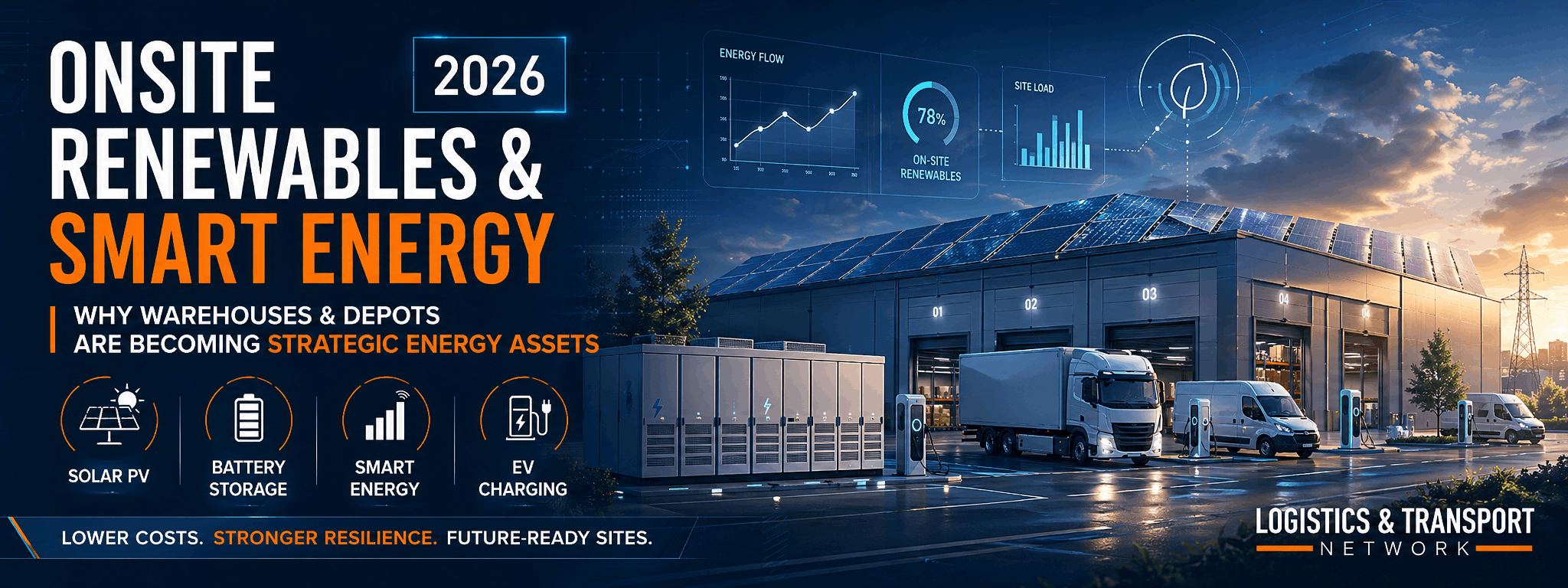
Energy volatility, rising non-commodity charges and fleet electrification are changing the role of UK logistics sites. Here’s why warehouses and depots are becoming strategic energy assets — and the practical steps operators can take now with supplier support.
For years, energy has been treated by many logistics operators as a background overhead: necessary, costly, and largely outside their control.
That is now changing.
In 2026, warehouses, depots and logistics sites are no longer just places where goods are stored, sorted, loaded and moved. They are becoming strategic energy assets.
The reason is simple. Logistics sites often combine three powerful characteristics: large roof space, high and predictable electricity demand, and growing pressure to support electric vehicle charging.
When onsite renewables, battery storage, smart energy management and EV charging are planned together, the energy equation changes. A warehouse or depot can move from being a passive energy consumer to an active part of the operator’s cost, resilience and decarbonisation strategy.
This is not just about “going green”.
It is about protecting margins, improving energy security, strengthening customer confidence and preparing sites for the next phase of fleet electrification.
The question is no longer whether onsite renewables make sense for logistics sites.
It is how quickly and effectively operators can assess the opportunity, design the right system and turn energy from a cost centre into a strategic advantage.
Why Energy Strategy Is Now a Logistics Strategy
For logistics operators, energy is no longer just a utility bill.
It now affects operating costs, customer contracts, depot resilience, ESG reporting, fleet electrification plans and long-term competitiveness.
Warehouses and depots are becoming active energy sites, where decisions around rooftop solar, battery storage, EV charging, tariffs, demand management and grid capacity directly affect how the business performs.
That means energy can no longer sit separately from fleet, property, finance and operations.
The operators that treat energy as a strategic asset will be better placed to manage volatility, support electric fleets, and build a stronger commercial case for future investment.
The operators that continue treating energy as a background overhead may find themselves exposed to higher costs, grid constraints and customer expectations they are not ready for.
What Is Driving the 2026 Opportunity?
Several pressures are converging at the same time.
Energy price volatility remains a live risk.
Even where wholesale prices appear more stable than during the peak of the energy crisis, high-consumption sites remain exposed to market movements, contract timing and sudden cost changes.
Non-commodity costs are adding pressure.
Network charges, capacity costs, balancing charges and wider system costs can keep energy bills under pressure even when wholesale markets soften. For large warehouses and depots, these charges can represent a major part of the bill.
Fleet electrification is increasing site demand.
As electric vans, trucks and workplace charging become more common, many depots will need significantly more electricity than they use today. The question is not only how operators will power their buildings, but how they will power their next generation of vehicles.
Customer and ESG expectations are rising.
More customers are asking suppliers to evidence lower-carbon operations, Scope 3 progress and credible decarbonisation plans. Logistics operators that can demonstrate lower-emission warehousing, transport and fulfilment will be better placed in tenders and contract discussions.
Technology and finance models have matured.
Solar PV, battery storage, smart controls, energy monitoring and EV charging systems are now much more established. At the same time, power purchase agreements, funded solar, leasing and energy-as-a-service models are making onsite energy projects accessible to operators that may not want to commit large upfront capital.
For warehouses and depots with large roof areas and predictable energy use, the opportunity is increasingly difficult to ignore.
Why Warehouses and Depots Are So Well Positioned
Not every commercial building is equally suited to on-site renewables and smart energy.
Logistics sites have natural advantages.
Many warehouses and depots have large, relatively unobstructed roof areas that can support solar PV. They also often have high daytime electricity demand, which aligns well with solar generation. This matters because the strongest solar business cases usually come where the site can use a high proportion of the power it generates.
Depots also have a unique advantage because many are now planning for EV charging. That creates a clear reason to think about solar, battery storage and smart charging as one integrated system rather than separate projects.
A well-planned logistics energy system can help operators:
- Reduce reliance on grid electricity
- Lower exposure to energy price volatility
- Make better use of existing site capacity
- Support EV charging growth
- Reduce peak demand charges
- Improve resilience during periods of grid pressure
- Strengthen carbon and ESG reporting
- Create a more credible long-term electrification plan
The best sites are not simply installing panels.
They are designing energy systems around how the depot actually operates.
The EV Charging Link: Why Solar Alone Is Not Enough
Solar PV can be powerful for logistics sites, but the biggest gains come when it is integrated properly.
As electric vans, trucks and workplace charging grow, many depots will see electricity demand rise sharply. If that demand is not managed, operators risk higher peak charges, capacity constraints and expensive grid upgrade requirements.
This is why solar alone is not always enough.
The strongest opportunity often comes from combining:
- Rooftop solar PV
- Battery storage
- Smart charging
- Load management
- Energy monitoring
- Flexible tariffs
- EV charging infrastructure
- Future site capacity planning
Together, these technologies allow operators to generate energy onsite, store it when useful, charge vehicles more intelligently, reduce demand peaks and make better use of available grid capacity.
For some sites, this can also reduce the scale or timing of future grid upgrades.
For others, it can strengthen the commercial case for electrification by lowering the effective cost of charging vehicles.
The key point is that depot electrification is not just a vehicle or charger decision.
It is an energy strategy decision.
Grid Capacity Is Becoming a Planning Issue
For some logistics sites, the biggest barrier to electrification will not be vehicle availability or charger choice.
It will be whether enough power can be brought to the site at the right time and at a viable cost.
Grid connection delays, capacity constraints and DNO upgrade requirements can all affect depot electrification plans. Operators that wait until vehicles are ordered before reviewing site power may find themselves facing delays, additional costs or limited charging capacity.
Onsite renewables, battery storage and smart controls cannot solve every grid constraint.
But they can help operators make better use of the capacity they already have.
They can also form part of a phased strategy, allowing sites to reduce grid reliance, manage peaks and support early-stage EV charging while longer-term infrastructure plans are developed.
This is why energy assessment needs to happen before major fleet electrification decisions are made.
The question is not simply: “Can we install chargers?”
It is: “Can this site support the energy demand of our future operation?”
Current and Future Impacts for UK Logistics Sites
Right Now
Many logistics operators are still exposed to energy cost volatility with limited onsite generation or storage.
For high-consumption warehouses and depots, this creates several immediate pressures:
- Energy bills remain difficult to forecast
- Non-commodity costs continue to add pressure
- EV charging plans are being developed without full site energy modelling
- Customer and tender requirements are asking more questions about carbon and energy performance
- Finance teams are looking for clearer ROI before approving capital projects
- Operations teams need solutions that reduce risk rather than add complexity
At the same time, suitable sites may now have a stronger case than ever for reviewing solar, batteries and smart energy systems.
Looking Ahead
Between 2026 and 2030, the gap between proactive and reactive operators is likely to widen.
Operators that invest in integrated onsite energy systems may benefit from:
- Lower and more predictable energy costs
- Better control over EV charging demand
- Reduced exposure to grid constraints
- Stronger carbon reporting and customer tender positioning
- Improved site resilience
- Greater ability to scale electrification over time
Operators who delay may face:
- Higher effective energy costs
- Greater exposure to grid stress and capacity constraints
- More expensive future infrastructure upgrades
- Weaker ESG evidence in customer discussions
- Slower EV transition planning
- Less control over long-term operating costs
In simple terms, an energy strategy is becoming part of a competitive strategy.
From Payback to Long-Term Value
For suitable commercial sites, the economics of onsite renewables can be attractive, particularly where the site has high daytime demand and can consume much of the energy generated.
But operators should avoid looking at payback in isolation.
A stronger business case considers the full value of the system, including:
- Reduced energy purchases from the grid
- Protection from price volatility
- Lower peak demand exposure
- Improved EV charging economics
- Stronger ESG and tender performance
- Potential battery optimisation
- Reduced operational risk
- Future site resilience
- Asset value and landlord/tenant considerations
For some businesses, a capital purchase may be the right route.
For others, a power purchase agreement, funded solar model, lease structure or energy-as-a-service approach may be more suitable.
The important point is that onsite renewables are no longer limited to operators with large available capital budgets.
The finance market has evolved, and suppliers can now support a range of ownership and funding models.
Your 2026 Proactive Action Plan
The opportunity is strong, but operators need a structured approach.
The best projects are not built around installing the biggest possible system. They are built around understanding the site, the demand profile, the operational plan and the future energy requirement.
Phase 1: Assess and Quantify
Operators should start by identifying their highest-consumption sites and reviewing where onsite energy could deliver the strongest return.
This should include:
- Current electricity consumption
- Half-hourly usage data where available
- Roof size, condition and orientation
- Existing grid capacity
- Current energy contract and tariff structure
- Non-commodity charges
- Future EV charging plans
- Operational patterns and vehicle dwell times
- Landlord, lease or planning considerations
The aim is to understand where the opportunity is strongest and which sites should be prioritised first.
Phase 2: Model the Future Demand
The biggest mistake is designing a system only around today’s energy use.
Warehouses and depots need to model future demand, especially where EV charging, automation, refrigeration, lighting upgrades, heat pumps or site expansion may increase electricity requirements.
Operators should ask:
- How many electric vehicles could this site need to support?
- When will vehicles charge?
- What charging speed will be required?
- What is the likely peak load?
- Could smart charging reduce pressure?
- Would battery storage improve the business case?
- Could solar generation be matched to charging or warehouse demand?
- Would grid upgrades be needed now or later?
This stage is essential because the right system should support the future operation, not just the current energy bill.
Phase 3: Design the Right Integrated Solution
Once demand is understood, operators can work with suppliers to design an integrated solution.
This may include:
- Solar PV
- Battery storage
- Smart energy controls
- EV charging infrastructure
- Load management
- Monitoring and reporting tools
- Grid connection planning
- Tariff optimisation
- Maintenance and performance management
The goal is to design a system that works commercially and operationally.
A poorly matched system can underperform. A well-designed system can reduce costs, improve resilience and support future fleet electrification.
Phase 4: Review Finance and Delivery Options
Operators should then assess the most suitable finance and delivery model.
Options may include:
- Capital purchase
- Power purchase agreement
- Funded solar
- Leasing
- Battery-as-a-service
- Energy-as-a-service
- Landlord-funded or shared-benefit models
- Green finance or asset finance
The right route will depend on ownership structure, cash flow, energy usage, contract length, landlord position and the operator’s appetite for upfront investment.
This is where specialist suppliers and finance partners can help turn a technical opportunity into a deliverable commercial project.
Phase 5: Implement, Monitor and Optimise
Installation is not the end of the process.
The best operators will continue to monitor system performance, energy savings, EV charging demand, battery behaviour and carbon reduction outcomes.
Ongoing monitoring allows operators to:
- Check whether savings are being achieved
- Optimise when energy is stored, used or exported
- Adjust charging patterns
- Identify maintenance issues
- Improve reporting for customers and ESG requirements
- Plan future expansion
Smart energy systems should become part of ongoing operational management, not a one-off project.
Supplier Solutions Making It Easier Than Ever
The market has matured significantly, and operators no longer need to navigate this alone.
A growing supplier ecosystem is now helping logistics operators assess, design, fund and deliver onsite energy projects.
This includes:
Commercial solar PV specialists
Designing and installing rooftop solar systems for warehouses, depots and logistics parks.
Battery storage providers
Helping sites store excess generation, reduce peak demand and improve resilience.
Smart energy management platforms
Using data and automation to optimise when energy is generated, stored, consumed or exported.
Integrated EV charging and renewables providers
Designing charging infrastructure around onsite generation, load management and future vehicle demand.
Grid connection and DNO specialists
Helping operators understand site capacity, upgrade requirements and connection timelines.
Energy consultants and auditors
Assessing current consumption, future demand and the commercial case for different solutions.
Finance and PPA providers
Offering funded models that reduce or remove the need for upfront capital.
Maintenance and performance partners
Ensuring systems continue to perform and deliver value after installation.
The right supplier can help operators avoid common mistakes, including undersized systems, poor battery integration, weak monitoring, unrealistic savings assumptions or EV charging plans that do not match real operations.
Real Momentum Is Building
Across the UK, the direction of travel is clear.
Commercial and industrial energy users are increasingly reviewing onsite generation not as a sustainability add-on, but as a way to manage volatility, reduce grid dependence and support electrification.
For logistics operators, the opportunity is particularly strong because warehouses and depots often combine large roofs, predictable consumption and growing EV charging demand.
Major retailers, logistics providers, manufacturers and 3PLs are already assessing or deploying onsite energy projects at distribution centres and operational sites.
Those that move early are better placed to secure supplier capacity, assess grid requirements, structure finance and build energy performance into customer conversations.
This is not about chasing a trend.
It is about recognising that energy is becoming part of logistics infrastructure.
The Bottom Line
Warehouses and depots are no longer just energy users.
They are becoming strategic energy assets.
For UK logistics operators, onsite renewables and smart energy systems represent one of the clearest opportunities in 2026 to reduce costs, improve resilience, support electrification and strengthen customer confidence.
But the strongest results will come from planned, integrated projects.
Solar, batteries, EV charging, tariffs, grid capacity and smart controls need to be considered together.
The operators that act now can build more resilient, lower-cost and future-ready sites.
The operators that delay may find energy costs, grid constraints and electrification demands becoming harder to manage.
The opportunity is real.
The question is whether your organisation is ready to capture it.
Join the Smart Energy & Depot Renewables Series
To support operators through this next phase of energy planning, the Logistics & Transport Network will be developing a focused Smart Energy & Depot Renewables Series.
The series will help UK logistics, warehousing, depot and fleet operators understand:
- How to assess whether a site is suitable for solar PV
- Where battery storage can improve the business case
- How smart energy management supports cost control and resilience
- Why EV charging, solar, and storage should be planned together
- What grid capacity and DNO constraints could mean for future operations
- How finance, PPAs and funded models can reduce upfront barriers
- Which supplier partners are actively supporting logistics operators with on-site energy projects
This series is designed to give operators practical guidance, supplier insight and a clearer route through the decisions that need to be made now.
To enrol your organisation or register interest in receiving the series, email:
Energy volatility may remain a challenge, but with the right planning, technology and supplier support, UK warehouses and depots can become stronger, smarter and more resilient energy assets.