

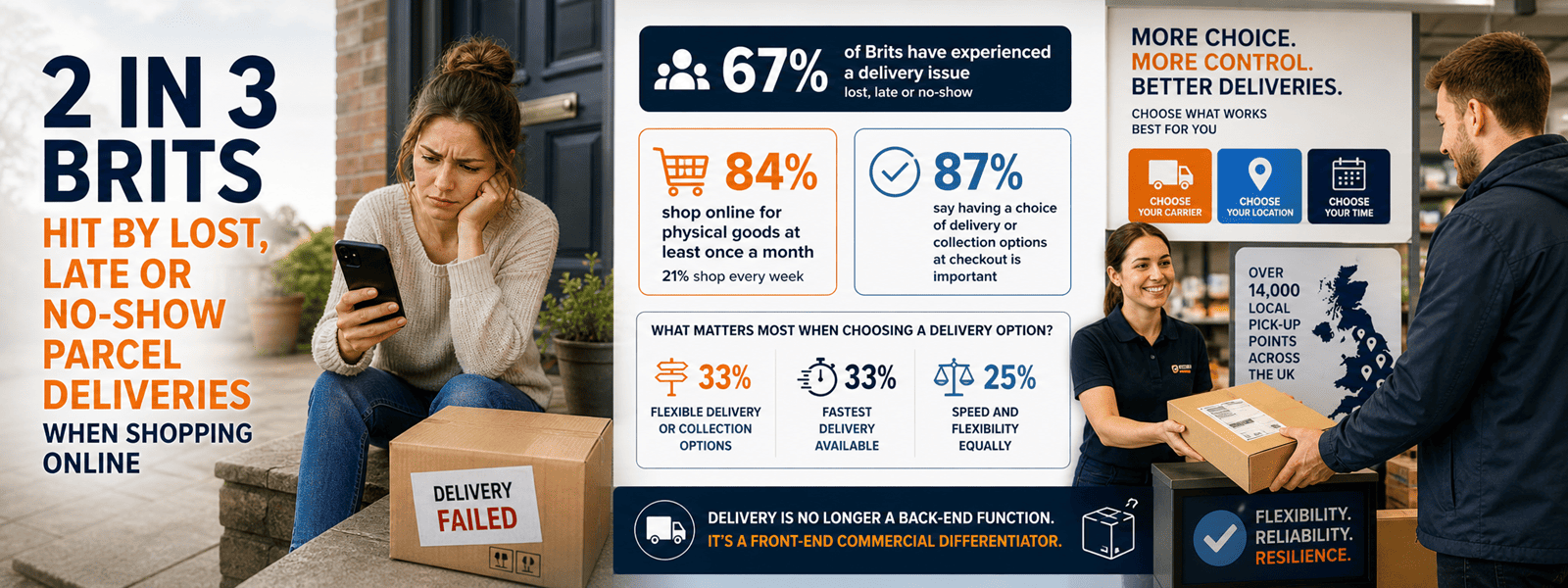
2 in 3 Brits Hit by Lost, Late or No-Show Parcel Deliveries When Shopping Online
Delivery failure is no longer a fringe frustration for UK shoppers — it is mainstream.
New research from Collect+ has found that two thirds of British consumers have experienced a delivery issue when shopping online, whether that is a delay, a missed delivery or a parcel lost entirely.
For retailers already navigating a difficult trading environment, the findings are a wake-up call.
The research also reveals just how central delivery has become to the online shopping decision. An overwhelming 87% of UK consumers say having a choice of delivery or collection options at checkout is important to them — placing it firmly alongside price and product availability as a core part of the purchase experience.
A Nation of Online Shoppers With Rising Expectations
The scale of online shopping in Britain makes these findings hard to ignore. The survey found that 84% of UK consumers now shop online for physical goods at least once a month, with one in five doing so every week.
As volumes grow, so does consumer scrutiny of what happens after the buy button is pressed.
Retailers are feeling the squeeze from both directions. Rising operating costs — including increases to National Insurance contributions and the minimum wage — are compressing margins, while shoppers are simultaneously demanding faster, more flexible and more reliable delivery.
Getting fulfilment wrong is no longer just a customer service issue. It is a commercial risk.
Speed Alone Is Not Enough
The research challenges a long-held assumption in e-commerce: that faster always wins.
When asked what matters most when choosing a delivery option, a third of consumers prioritised flexible delivery or collection options — the same proportion as those who said fastest delivery available. A further quarter said speed and flexibility matter equally to them.
The message for retailers is clear. Competing on speed alone leaves a significant portion of customers underserved.
Flexibility — the ability to choose a carrier, a time slot or a convenient local collection point — is now just as important as how quickly a parcel arrives.
The Case for Carrier-Agnostic Networks
Against this backdrop, carrier-agnostic delivery networks are gaining traction as a practical solution for retailers looking to build resilience into their operations.
Collect+, which operates across a network of more than 14,000 local retailers, offers a platform that allows consumers to choose the carrier, service or location that works best for them — rather than being locked into a single provider’s availability or performance.
“Delivery choice is no longer a nice-to-have. It is a core part of the customer experience.”
— Sam Holden, Director of Parcels and E-Commerce at PayPointHolden said the research reinforces what retailers are already feeling on the ground, with rising operational costs on one side and improving customer expectations on the other.
“Consumers want flexibility, reliability and control. Our multi-carrier approach gives retailers more resilience in their delivery operations.”
— Sam Holden, Director of Parcels and E-Commerce at PayPointWhat This Means for Retailers
The direction of travel is unambiguous. Delivery is no longer a back-end logistics function — it is a front-end commercial differentiator.
Retailers who treat it as such, by broadening their carrier options, investing in flexible fulfilment and reducing single-provider dependency, will be better placed to retain customers in an environment where a missed parcel can mean a lost sale and a lost customer.
Want to Sponsor Articles Like This?
Put your brand in front of logistics, transport and e-commerce decision-makers through sponsored editorial placements on Logistics and Transport Network.
Contact Us