
For logistics and transport operators, energy is no longer just another utility cost in the background.
Warehouses, depots, cold storage facilities, distribution hubs and operating sites all depend on consistent, affordable and predictable power. Lighting, refrigeration, heating, cooling, warehouse equipment, security systems, IT, loading operations and general site activity all place demand on the electricity supply.
As energy costs remain a major concern for businesses across the sector, many operators are now asking a bigger question:
Can our buildings do more than simply consume energy?
This is where commercial solar PV and battery storage are becoming a much more important conversation across logistics and transport.
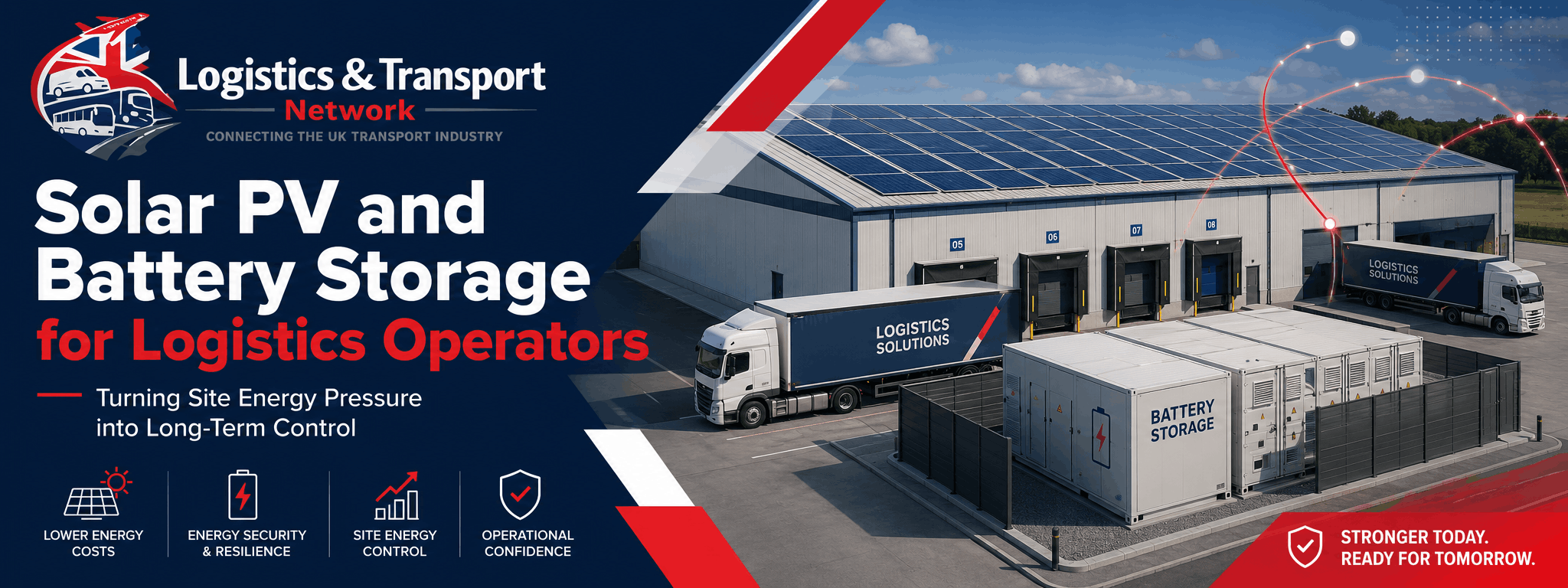
For suitable sites, rooftop solar can help reduce reliance on grid electricity, lower exposure to price volatility and turn unused roof space into a long-term operational asset. When combined with battery storage, operators can make better use of the power they generate, store energy for when the site needs it most and create a more resilient approach to energy management.
The opportunity is not simply about installing panels.
It is about giving logistics businesses greater control over one of their most important operating costs.
Why solar and battery storage are now being reviewed more seriously
Across the logistics and transport sector, operators are under pressure to manage costs, improve efficiency, strengthen resilience and provide clearer evidence of environmental responsibility.
For many businesses, energy sits at the centre of all four.
A warehouse or depot with high electricity demand is directly exposed to changes in energy pricing. A cold storage site may face even greater pressure because refrigeration and temperature-controlled operations can be business-critical. A multi-site logistics business may also be looking for consistency across its property portfolio and a clearer way to plan long-term energy use.
Solar PV and battery storage can help address these challenges by allowing suitable sites to generate and use more of their own electricity.
For operators with the right premises, this can support:
- lower grid electricity consumption
- more predictable site energy costs
- better use of unused roof space
- reduced exposure to future price movement
- stronger carbon reduction evidence
- improved resilience and continuity planning
- a more structured long-term energy strategy
This is why the conversation has moved beyond a simple cost-saving exercise.
For many operators, solar and battery storage are now being reviewed as part of wider business resilience, cost control and site asset planning.
The opportunity: turning the roof into a working asset
Many logistics sites have one of the most valuable ingredients for solar PV: large roof space.
Warehouses, depots and distribution centres often have significant roof areas that may currently be doing very little for the business. Where the roof is suitable, solar PV creates an opportunity to turn that space into a productive energy asset.
Instead of buying all electricity from the grid, the site can generate a portion of its own power during daylight hours. This can reduce the amount of electricity purchased, improve long-term cost visibility and support sustainability objectives.
Battery storage can strengthen the opportunity further.
Where solar generation is higher than immediate site demand, battery storage can hold that energy for later use. This can be particularly useful where the site has demand outside peak solar generation hours, or where the operator wants to increase the amount of generated power used on site rather than exported.
The positive outcome is clear.
A suitable logistics site can move from being a passive energy consumer to a more active and controlled energy operation.
The question is not “can we install solar?” — it is “what is the right energy model for this site?”
One of the most important points for operators is that solar should not be treated as a generic installation.
Two logistics sites may look similar from the outside but have completely different energy profiles, roof conditions, operating hours, tariffs and commercial objectives.
That means the right solution is not always the largest possible solar system.
The right solution is the system that matches the site.
A strong review should consider:
- how much electricity the site uses
- when that electricity is used
- how much roof space is genuinely usable
- how much solar power can be consumed on site
- whether battery storage improves the business case
- whether export is valuable or limited
- whether the roof is suitable
- how long the business expects to remain at the site
- what finance model best supports the operator’s goals
This is where informed decision-making makes the biggest difference.
A well-designed system can support cost control, resilience and carbon reduction. A poorly matched system can create confusion, weaker returns and avoidable complications.
The aim should always be to build the right model around the site, not force the site around a standard proposal.
The biggest questions logistics operators should be asking
1. Will solar genuinely reduce our energy costs?
This is usually the first question, and rightly so.
The answer depends on the relationship between solar generation and site consumption.
A business that can use a high proportion of generated electricity on site may see a stronger commercial case, because every unit of solar power used directly reduces the amount of electricity bought from the grid.
However, the savings depend on several factors:
- current electricity tariff
- site demand profile
- system size
- level of self-consumption
- export value
- battery storage requirements
- finance route
- maintenance costs
- long-term energy assumptions
This is why operators should be cautious of headline savings without clear assumptions behind them.
A credible proposal should show how savings are calculated, how much power is expected to be used on site, how much may be exported and what role battery storage plays in improving the overall case.
2. What role does battery storage actually play?
Battery storage is becoming a central part of the solar conversation, but it needs to be understood properly.
A battery is not just an add-on. It can change how the whole system performs.
For logistics and transport sites, battery storage can help by:
- storing excess solar generation for later use
- increasing the amount of generated power used on site
- reducing reliance on peak-rate grid electricity
- supporting evening, overnight or irregular demand patterns
- improving resilience during periods of energy pressure
- reducing wasted export where export values are low
- helping smooth demand across the day
This can be especially valuable where a site’s energy use does not perfectly match solar generation hours.
For example, a depot or warehouse may generate strong solar output during the day but still have an important electricity demand later in the evening, early morning or overnight. Battery storage may help bridge that gap.
However, battery storage is not automatically required for every site.
The decision should be based on actual consumption data, tariff structure, generation forecasts, export position and resilience requirements.
The most valuable question is not simply: “Should we add a battery?”
It is:
“Would battery storage help this site use more of its own power, reduce cost exposure or improve resilience?”
3. Is our roof suitable?
Roof suitability is one of the biggest practical considerations for logistics operators.
Large roof space is an advantage, but it does not automatically mean the building is ready for solar PV.
Operators need to understand:
- roof age
- roof condition
- structural load capacity
- orientation
- shading
- access
- skylights
- vents
- plant and equipment
- insurance requirements
- maintenance access
- warranty implications
- planned roof works
This is a vital part of the decision.
If a roof is approaching replacement or needs significant repair, it may make sense to coordinate roof work and solar planning together. Installing solar on a roof that may need major work within a few years can create unnecessary disruption and additional cost.
For leased premises, there are further considerations.
The operator may need landlord consent, clarity around roof maintenance responsibilities, agreement over who owns the system and a clear understanding of how the benefits are shared.
None of these issues should prevent operators from reviewing solar. They simply need to be understood early so the project can be structured properly.
4. How much of the generated power can we actually use?
Self-consumption is one of the most important parts of the commercial case.
Using generated solar power directly on site is usually more valuable than exporting it. That is why understanding the site’s electricity usage pattern is essential.
Operators should review:
- when the site uses the most electricity
- whether demand is strongest during the day, evening or overnight
- how much power the site uses at weekends
- how seasonal demand changes
- whether refrigeration or equipment creates consistent demand
- how much generated power could be exported
- whether battery storage would improve self-consumption
This is where half-hourly electricity data becomes extremely useful.
It allows the system to be designed around how the site actually operates, rather than relying on estimates.
A site with strong daytime demand may be well-suited to solar PV alone. A site with more spread-out or irregular demand may benefit from battery storage. A site with lower electricity use may need a more carefully sized system to ensure the investment still makes sense.
The key is not to assume. The key is to model the opportunity properly.
5. What does this mean for energy resilience?
Energy resilience is becoming a bigger part of the discussion.
For logistics businesses, power is closely linked to operational continuity. Disruption can affect refrigeration, lighting, IT systems, security, access control, loading activity, warehouse equipment and wider site operations.
Solar PV and battery storage do not remove the need for grid power entirely, but they can help reduce full reliance on bought electricity and create a more controlled energy position.
For suitable sites, this can support:
- better cost predictability
- greater control over energy use
- improved continuity planning
- reduced exposure to external price movement
- stronger confidence in long-term site planning
This is one of the most positive outcomes for operators.
Solar and battery storage are not just about reducing bills today. They can help businesses build a stronger, more resilient energy position for the years ahead.
What needs to be understood before moving forward
Many logistics and transport businesses are interested in solar PV and battery storage, but are understandably cautious.
That caution is sensible.
Operators are not looking for generic promises. They need clear answers, practical guidance and confidence that the system being proposed is right for their business.
Before moving forward, the main areas to understand are:
Upfront cost and finance
Larger rooftop systems can require significant investment. Operators need to understand whether the project is best funded through capital expenditure, asset finance, a power purchase agreement or another finance model.
The right route will depend on cash flow, ownership preferences, balance sheet priorities and long-term site plans.
Payback and commercial assumptions
Payback is not just about installation cost. It depends on electricity usage, tariff, system size, self-consumption, export value, battery performance and future energy prices.
A strong proposal should explain the assumptions clearly.
Roof condition and structure
Older roofs, lightweight structures or buildings with warranty concerns may need further assessment before a system can be installed.
This should be identified early.
Landlord and tenant arrangements
Where the operator does not own the building, permission and commercial structure are important.
Lease length, landlord consent, roof maintenance, ownership of the system and allocation of savings all need to be considered.
Grid and export position
Some sites may face limits on how much power can be exported or may require further checks with the local network operator.
This does not necessarily stop a project, but it can affect system design and battery storage decisions.
Operational disruption
Logistics operators need reassurance that any installation can be planned around day-to-day activity.
The project should consider site access, working hours, safety, loading areas, roof access and operational continuity.
Proposal comparison
Operators may receive very different recommendations from different suppliers. To compare properly, they need to understand the assumptions behind each proposal rather than simply comparing headline savings or system size.
These are not reasons to delay indefinitely. They are the checks that help operators move forward with confidence.
What operators should prepare before reviewing solar and battery storage
A better outcome starts with better information.
Before requesting proposals, logistics and transport operators should gather:
- recent electricity bills
- half-hourly consumption data
- site address
- roof plans, if available
- roof age and condition
- details of any planned roof works
- lease or ownership status
- current tariff details
- operating hours
- seasonal demand patterns
- refrigeration or high-energy equipment details
- existing energy efficiency measures
- known grid or export limitations
- long-term site plans
This information allows the opportunity to be assessed properly.
It also helps avoid unsuitable recommendations, oversized systems or proposals that do not reflect how the site actually operates.
For operators at the early research stage, gathering this information is a powerful first step. It puts the business in control of the conversation before speaking to suppliers.
What a strong solar and battery proposal should include
A credible proposal should give operators a clear view of both the opportunity and the limitations.
It should explain:
- expected annual generation
- expected on-site usage
- expected export
- estimated annual savings
- payback period
- battery role and sizing
- roof assumptions
- structural requirements
- installation approach
- operational disruption planning
- maintenance requirements
- warranties
- finance options
- risks and limitations
- sensitivity to energy price changes
- long-term performance assumptions
Operators should be cautious of any proposal that focuses only on headline savings without showing the details behind the numbers.
A strong proposal should help the business make an informed decision, not pressure it into a quick one.
The positive outcome for operators
For logistics and transport operators, the opportunity is not just to install solar panels.
The opportunity is to take greater control of one of the most important operating costs in the business.
A well-designed solar PV and battery storage system can help a suitable site:
- reduce the amount of electricity bought from the grid
- make better use of unused roof space
- store generated power for later use
- Reduce wasted export
- improve protection against future energy price movement
- support carbon reduction targets
- strengthen customer and supply chain sustainability evidence
- improve long-term site resilience
- Create a clearer energy strategy for the business
This is why the conversation is becoming more important across the sector.
For many operators, the roof above the warehouse, depot or distribution centre may already be one of the most underused assets in the business. Solar PV and battery storage give businesses a way to turn that space into a working part of their energy strategy.
The operators that benefit most will be those that approach the decision properly: understanding their usage, their roof, their costs, their risks and their long-term site plans before moving forward.
That is the positive route forward.
Not rushing into a generic installation, but making an informed decision that gives the business greater control, greater confidence and a stronger long-term energy position.
Is solar PV and battery storage the right route forward?
For many logistics and transport operators, yes, where the site fundamentals are right.
The strongest opportunities are usually found where a business has:
- large usable roof space
- strong electricity demand
- high or rising energy costs
- long-term control of the site
- suitable roof condition
- clear sustainability objectives
- a desire for greater energy resilience
- the ability to use a high proportion of the generated power
Solar PV and battery storage will not be the right fit for every site. But for suitable logistics buildings, they can offer a practical and commercially meaningful way to reduce cost exposure, improve control and make better use of existing assets.
The key is to assess the opportunity properly before moving forward.
That means understanding the site, the data, the roof, the finance model, the battery case and the long-term operational plan.
When those elements are aligned, solar and battery storage can become far more than an energy-saving measure.
They can become part of a stronger, more resilient operating model.
Moving forward with confidence
For logistics and transport operators, solar PV and battery storage should not be seen as a quick bolt-on.
They should be reviewed as part of a wider site energy strategy.
The businesses that benefit most will be those that understand their consumption profile, roof suitability, finance options, resilience needs and long-term site plans before committing.
As energy costs, carbon expectations and operational pressures continue to shape the sector, the ability to generate and store power on-site could become a major advantage for operators with the right premises.
For those reviewing the opportunity now, the most important first step is simple:
Understand whether your site is suitable, how much energy you can realistically use, and whether battery storage strengthens the commercial case.
With the right assessment, solar PV and battery storage can give logistics and transport operators a clearer route to lower cost exposure, stronger energy control and long-term operational resilience.
If your business is reviewing solar PV, battery storage or wider site energy resilience, Logistics & Transport Network can help you understand what information to gather, what questions to ask and what type of support may be relevant to your site.
Whether you are at the early research stage or actively reviewing proposals, the most important first step is to understand whether your site is suitable and what commercial model makes sense for your operation.