

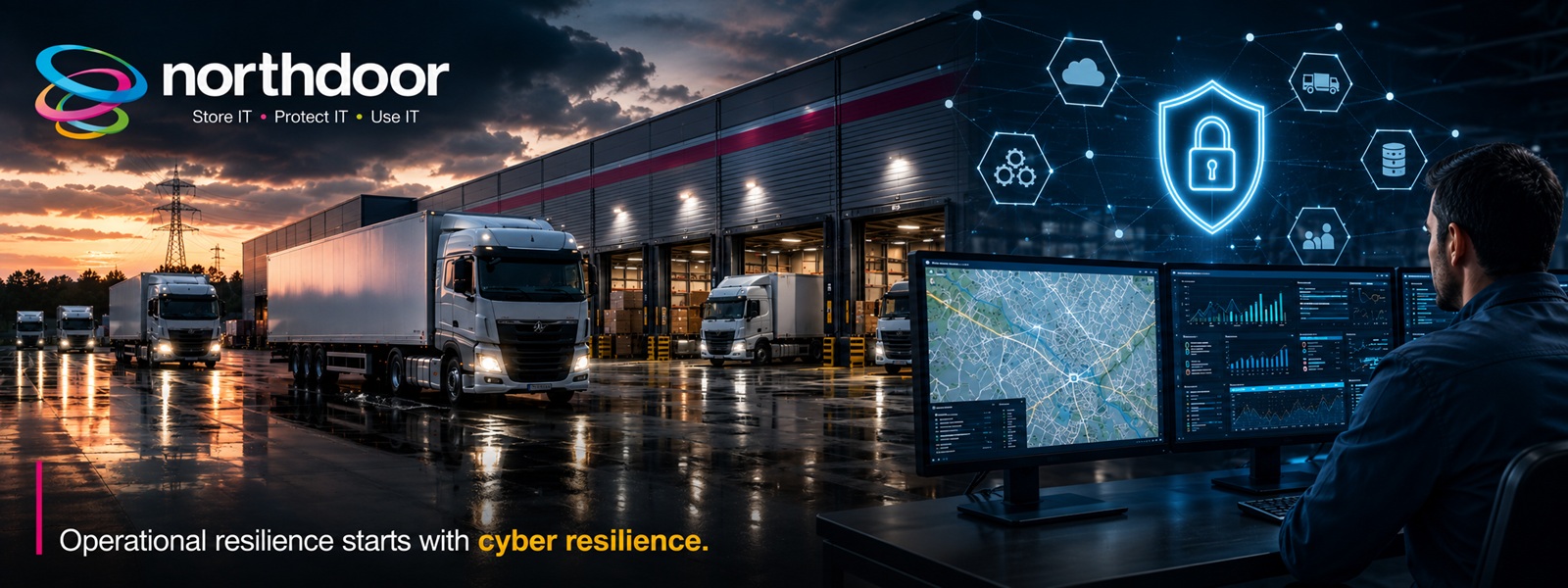
Could Your Logistics Operation Keep Moving for 72 Hours Without Its WMS, TMS or Telematics?
Critical systems now sit at the heart of modern logistics. But what happens when those systems suddenly disappear? For fleet, warehouse and transport operators, cyber resilience is rapidly becoming operational resilience.
For most logistics operators, resilience is measured in vehicles, drivers and depot capacity. Yet one of the greatest operational risks may not be sitting in the yard at all — it is running silently in the background.
Warehouse Management Systems (WMS), Transport Management Systems (TMS), telematics platforms, fleet maintenance software, ERP systems and customer portals have become the digital backbone of the modern logistics operation. Every collection, route optimisation, warehouse movement, proof of delivery and customer update can depend upon them.
If your WMS, TMS or telematics platform became unavailable tomorrow morning, how long could your operation continue before service levels, productivity and customer commitments began to suffer?
The Hidden Dependency Behind Modern Logistics
Logistics businesses have embraced digital transformation at pace. Routing is increasingly automated, vehicle movements can be tracked in real time, warehouse inventory updates instantly and customers expect visibility from collection through to final delivery.
These technologies have created enormous efficiencies. They have also created a new form of operational dependency.
Lose warehouse visibility and teams may struggle to locate, allocate and move stock accurately.
Lose transport systems and planners may lose access to routes, schedules, allocations and operational visibility.
Lose live fleet data and managers can quickly lose visibility of vehicles, drivers and operational performance.
Cyber security is no longer simply an IT issue. For logistics operators, it is increasingly an operational continuity issue.
Cyber Security Is Now Operational Resilience
Every hour that critical technology remains unavailable can have consequences across the wider organisation. Deliveries can be disrupted, warehouse productivity can fall, fleet utilisation can deteriorate and customer service teams can lose the information required to answer even basic operational questions.
Increasingly, boards are recognising that cyber resilience is another form of business resilience.
The organisations capable of recovering fastest are not necessarily those with the largest IT budgets. They are often the businesses that have understood their dependencies, prioritised their critical assets and planned for disruption before it happens.
Why Traditional Security Is No Longer Enough
Many organisations still rely heavily on security models originally designed to keep threats outside a defined corporate perimeter. Today’s operating environment is considerably more complex.
Cloud applications, mobile devices, hybrid working, connected operational technology, third-party suppliers and remote access have expanded the attack surface substantially.
Northdoor advocates a Zero Trust approach to cyber security. Rather than assuming a user, device or system can be trusted because it sits within the corporate environment, access is continually assessed and controlled.
Layered protection can be applied across users, devices, applications, databases and access points, helping organisations identify suspicious activity earlier, restrict the movement of threats and respond more decisively when incidents occur.
Building Resilience, Not Simply Buying More Security
Another challenge facing businesses is complexity. Years of technology investment can leave organisations operating numerous security tools, frameworks and platforms in separate functional silos.
Northdoor’s approach focuses on helping organisations build a coherent security environment rather than simply adding another standalone product.
Its cyber security capabilities are designed to help organisations apply layered protection, detect and halt attacks, proactively hunt for emerging threats, improve visibility of risk and use intelligent technology to help triage security events.
How Recovery Ready Is Your Operation?
Preventing an incident is only part of the resilience equation. Logistics leaders should also understand exactly how their business would operate while systems were unavailable — and how quickly those systems could realistically be recovered.
- How long could we operate without our WMS?
- Could planners continue working if our TMS failed?
- Are dispatch procedures documented outside the core system?
- How quickly could critical data and platforms be restored?
- When were recovery procedures last tested?
- Which suppliers represent critical technology dependencies?
- Would managers know their responsibilities during an incident?
- Can we communicate effectively if normal systems are unavailable?
A recovery plan that has never been tested under operational pressure may provide considerably less protection than leaders assume.
A Threat Landscape That Keeps Expanding
Today’s cyber threat landscape extends far beyond conventional viruses and malware.
Logistics businesses need to consider risks ranging from ransomware and phishing to credential theft, supply chain compromise, insider threats, social engineering and the increasing number of connected devices within the operational environment.
Potential routes into the modern logistics operation
For a logistics business operating around the clock, even a relatively contained cyber security event can therefore develop rapidly into a significant operational issue.
Start Small. Build Strong.
Strengthening resilience does not necessarily require a disruptive organisation-wide transformation from day one.
Northdoor’s approach enables businesses to begin with an identified security concern, implement an appropriate solution, demonstrate its value and then progressively build additional capabilities within a broader Zero Trust framework.
This provides logistics organisations with a practical path towards stronger security while maintaining the productivity and availability required by day-to-day operations.
A Board-Level Conversation
Operational resilience is no longer solely the responsibility of the IT department.
It directly affects commercial performance, customer relationships, compliance and organisational reputation.
Logistics businesses increasingly need to understand not merely whether their technology is secure, but what would happen to the operation when an important piece of technology is unavailable.
The question is therefore not simply whether your systems could experience disruption.
It is whether your organisation could continue serving its customers when they do.
Could Your Business Pass the 72-Hour Test?
If you are unsure whether your logistics operation could continue functioning without its WMS, TMS, telematics platform or other critical operational systems, now is the time to find out — rather than after an incident has already disrupted the business.
Northdoor helps organisations identify vulnerabilities, strengthen cyber security and develop practical approaches to operational resilience. Its specialists assess your existing environment, highlight areas of exposure and build a roadmap towards a more resilient Zero Trust cyber security strategy that protects users, devices, applications and critical business systems.
To learn more about Northdoor’s cyber security and operational resilience services, visit www.northdoor.co.uk.
Chief Commercial Officer
Northdoor plc
Learn more about AJ and his role at Northdoor here.